Brigitte Kowanz I Christoph Weber
»Geteilter Raum«
15 October – 20 November, 2021
Shaped light meets poured concrete, language meets form, lines charged with meaning meet broken mass, immaterial radiation meets solid cast stone. When approaching the works of Brigitte Kowanz and Christoph Weber for the first time, the difference could probably not be greater - and yet this selection of works from recent years allows commonalities to emerge. The dialogue between the two artists in the same space leads to surprising observations and potentially insightful paradoxes.
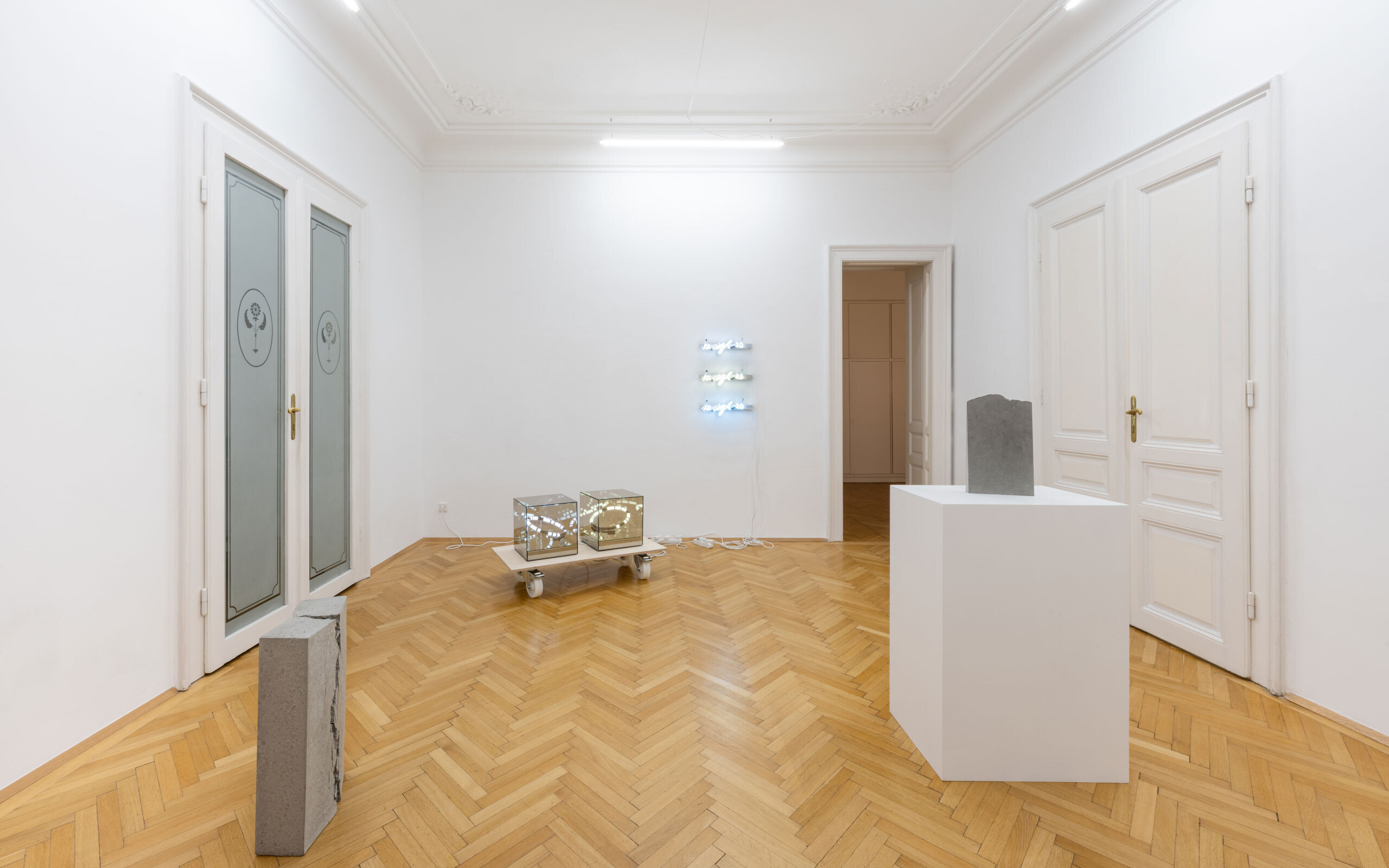
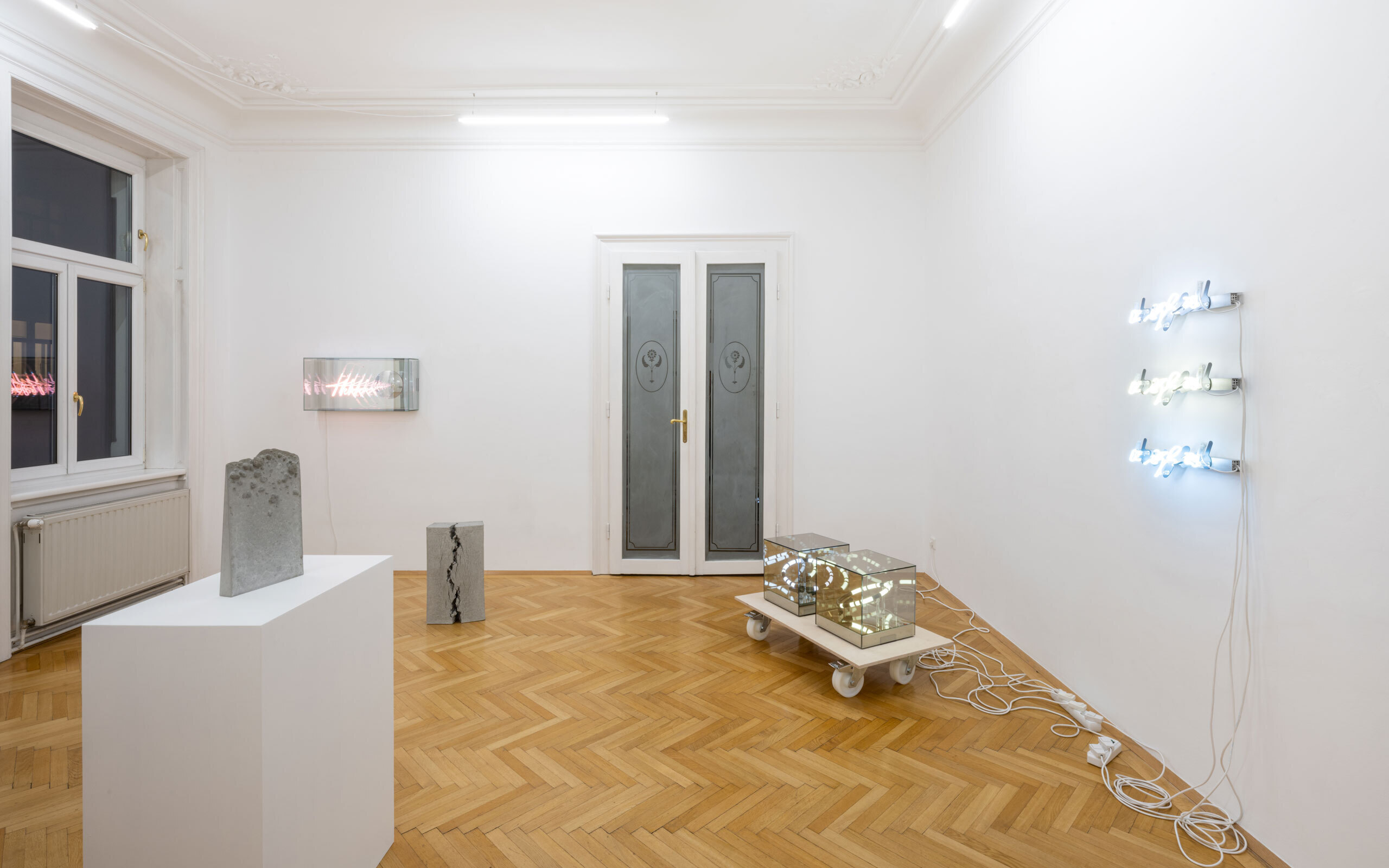
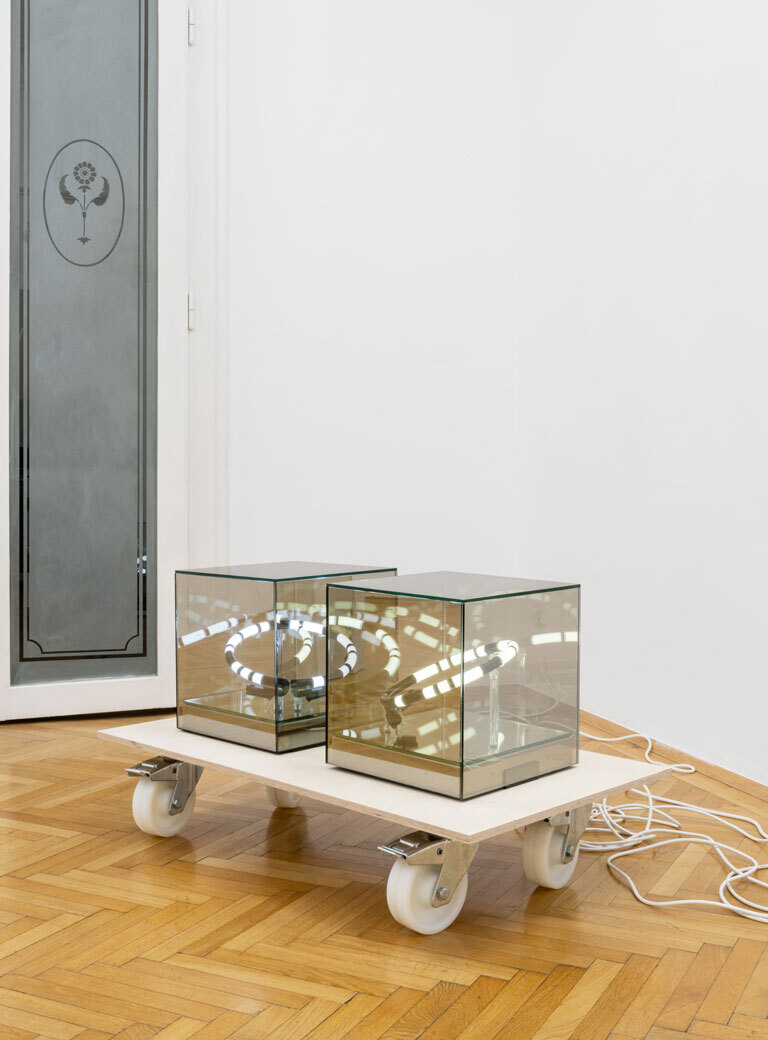
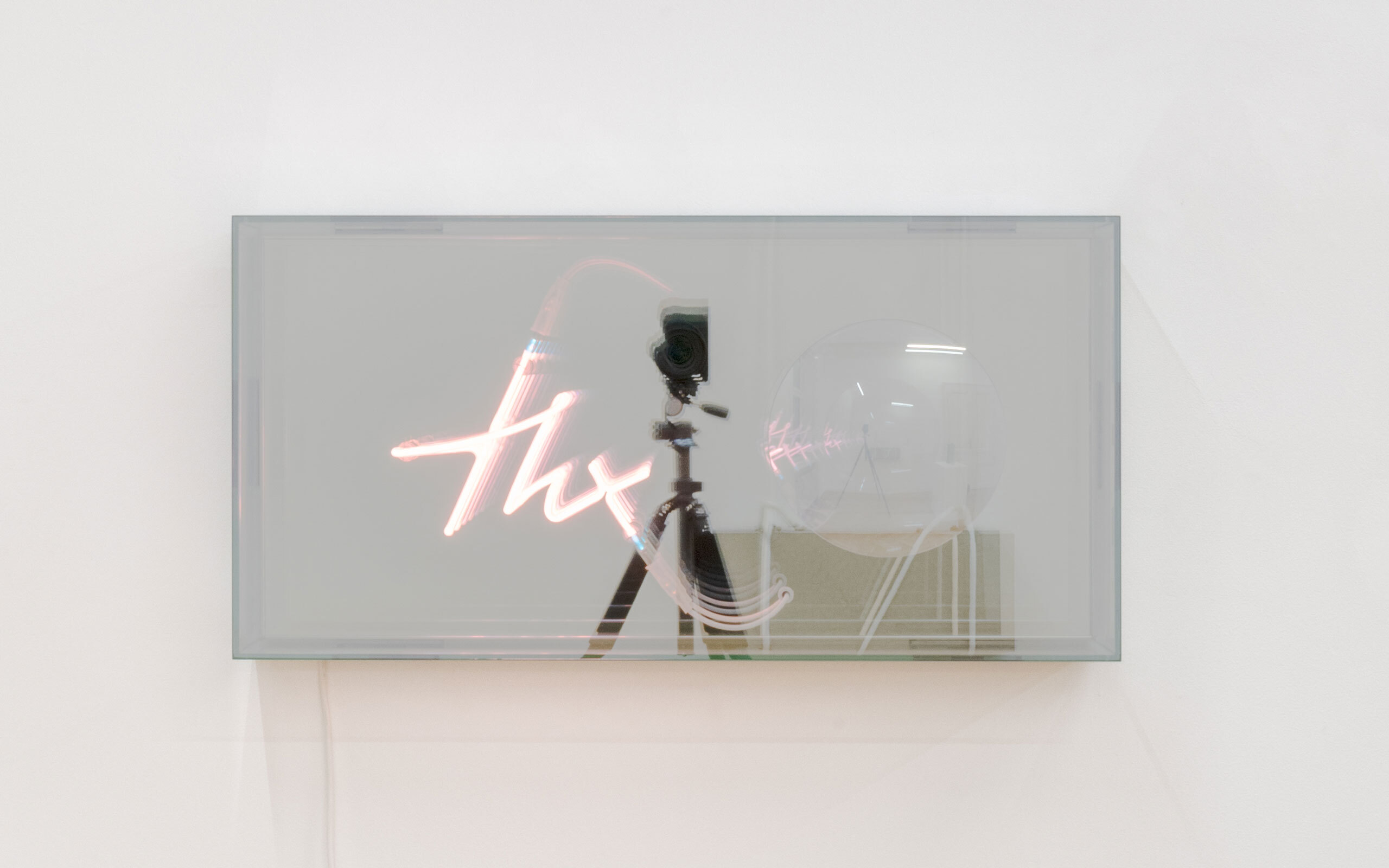
Brigitte Kowanz is one of Europe's most important light artists. In the exhibition she shows two of her mirrored cubes from 2014 bearing the titles Code and Space. On the walls thx (2020) and 12igh20 (2021) are hung. The artist responds to the exhibition space with precise settings on a linguistic level.
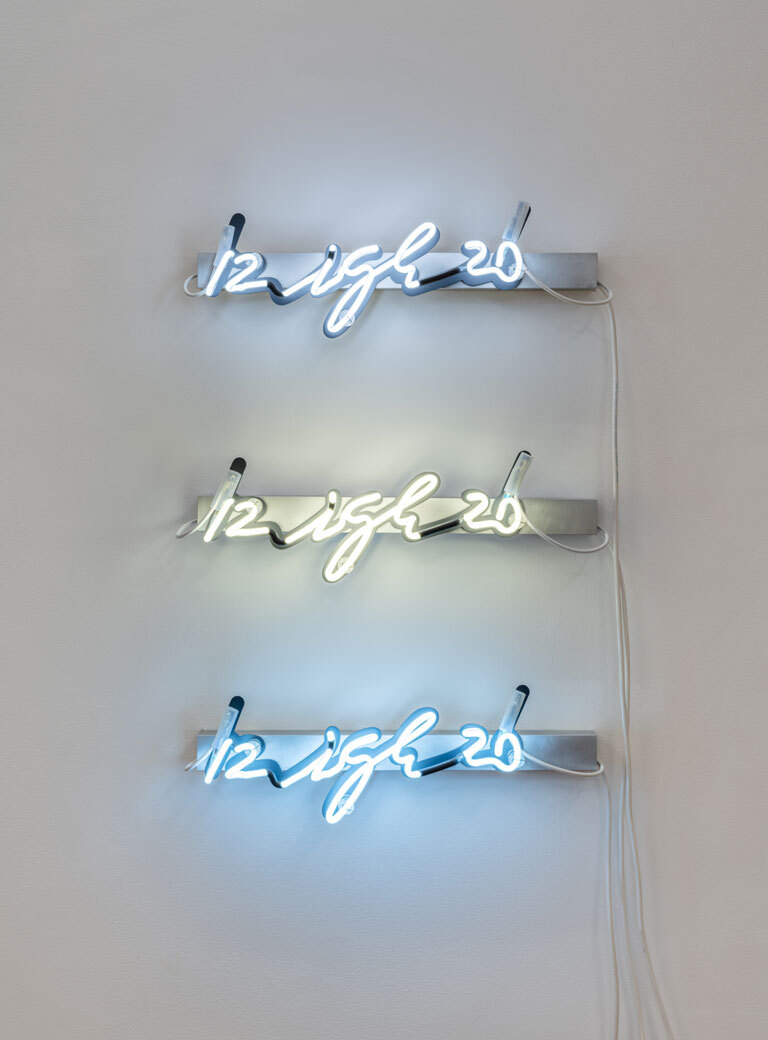
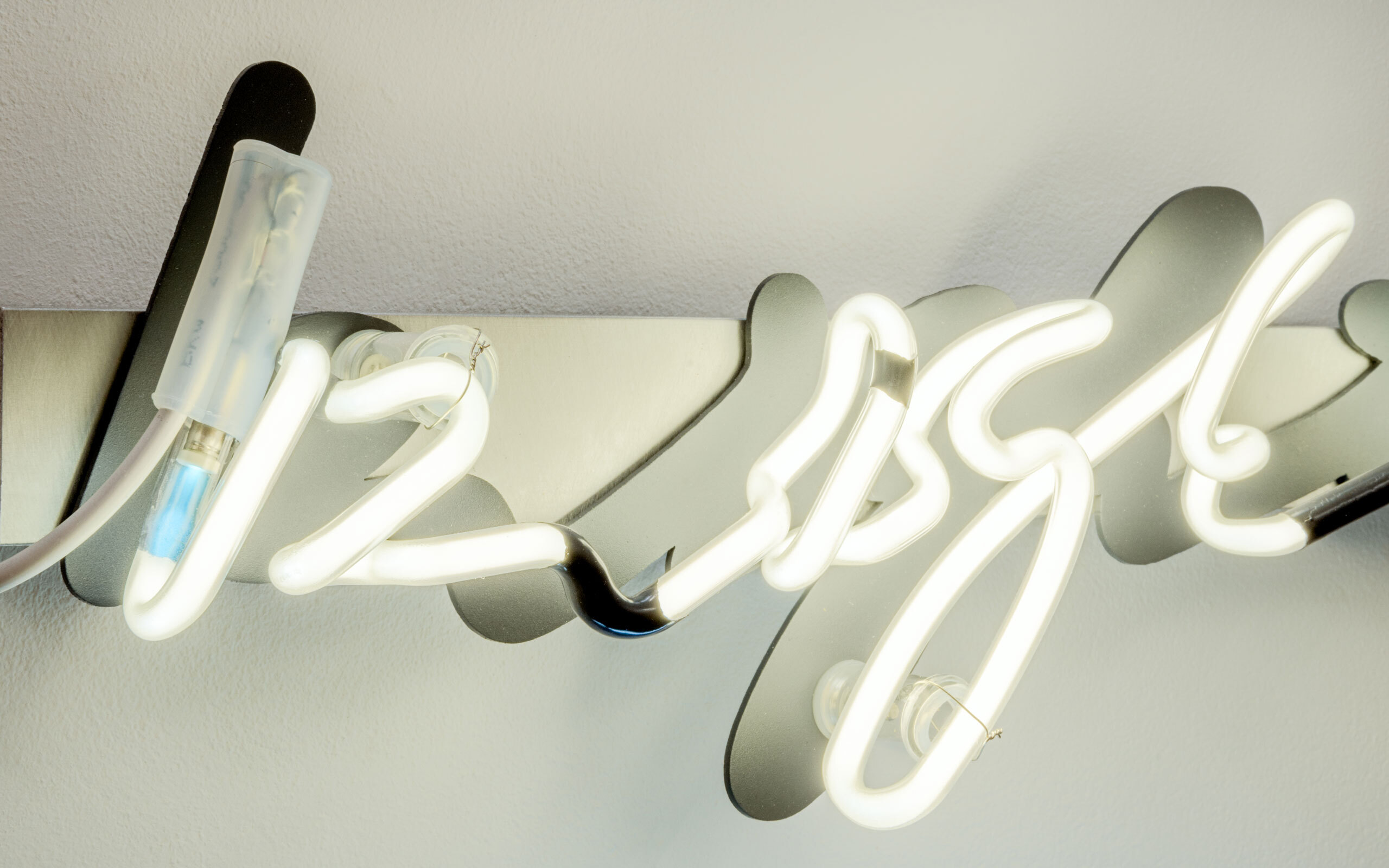
With the current work 12igh20, for example, she continues her series of self-referential light sculptures, replacing the initial and final letters of "light" with their position in the alphabet. "l" becomes 12 and "t" 20, with which the neon tube writes the English word for "light" but also for "lightweight" or " luminous" on the wall. Signifier and signified, designating and designated fall into one, semiotically speaking. Language becomes writing becomes drawing becomes light. The object illuminates in a double sense of the word, indicating what it is on a linguistic, material as well as metaphorical level. In this way, multi-layered feedback processes of mutually reinforcing meanings are created. With the help of different light temperatures and nuances, Kowanz' makes immaterial material tangible - and at the same time points to the linguistic vagueness of the term "light." What light, what lightness, what brightness is meant when Kowanz's light object writes 12igh20?
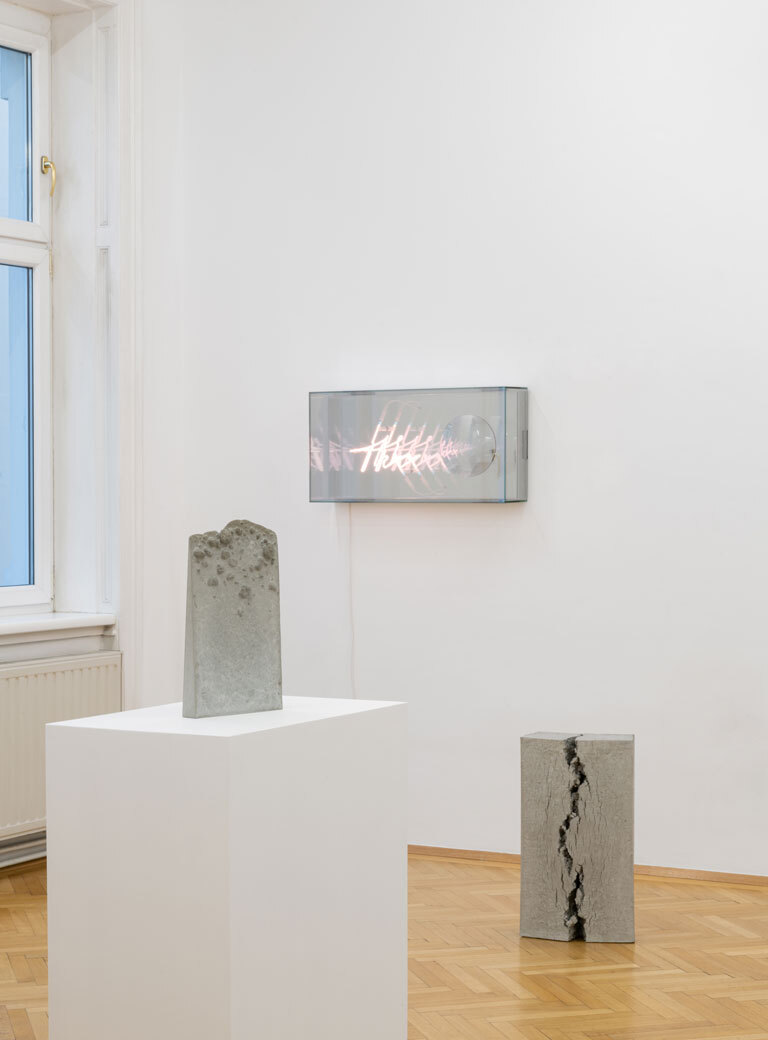
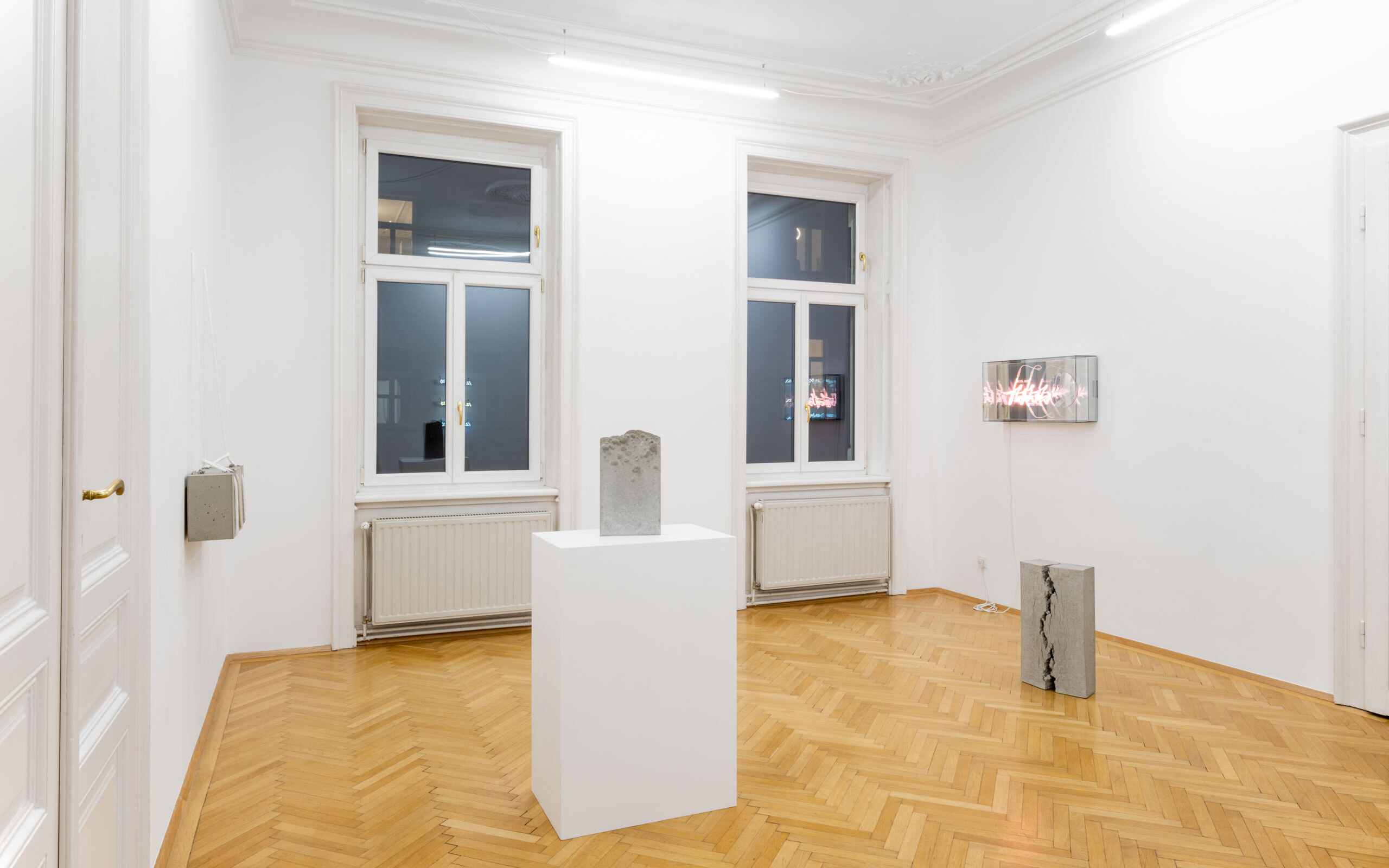
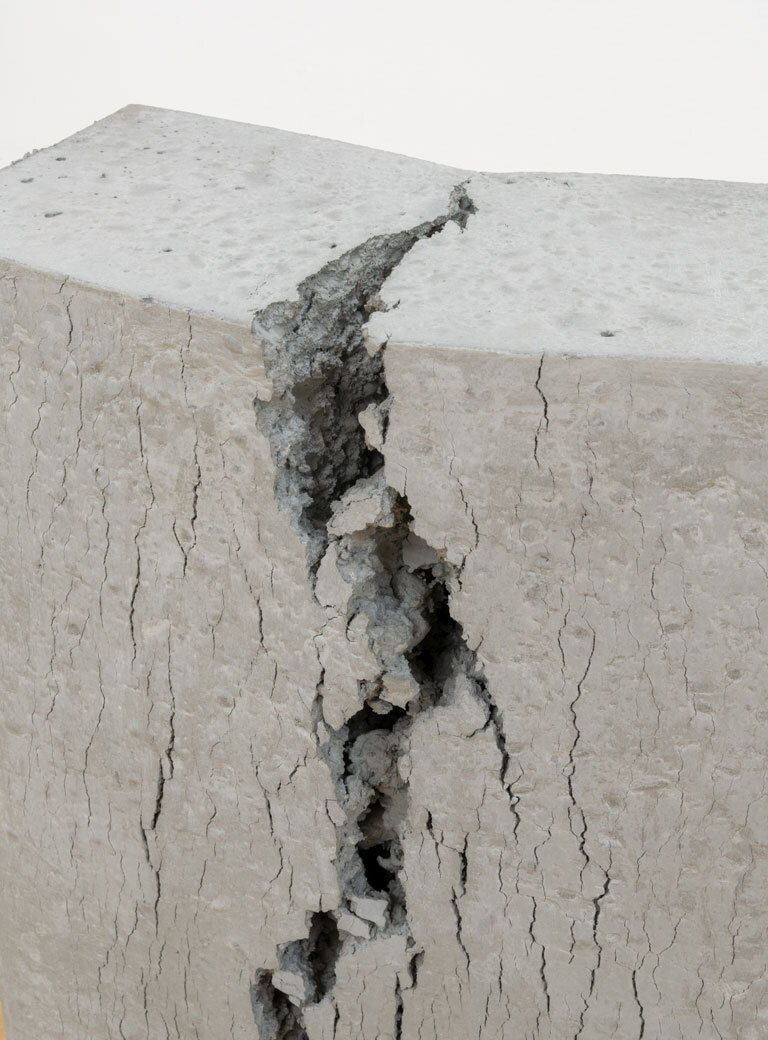
Christoph Weber's most important material, on the other hand, is concrete, from which he extract varied modes of expression through different processing techniques. Close Disclose (2020), but also not yet titled(2017) and Cast & Uncast (2019) clearly show how the sculptor experiments with mass and form. The success of concrete as a building material is fed by its malleability and hardness. Christoph Weber picks up on both qualities in order to counteract them at the same time. Concrete poured onto a sheet of Plexiglas can appear as smooth as glass, while cracks and fractures that Weber works into or allows to develop in the material during the drying process with the help of tension and gravity allow a view into the interior of the closed forms. The breakup of the concrete can thus be interpreted as undermining the paradigm of solidity.
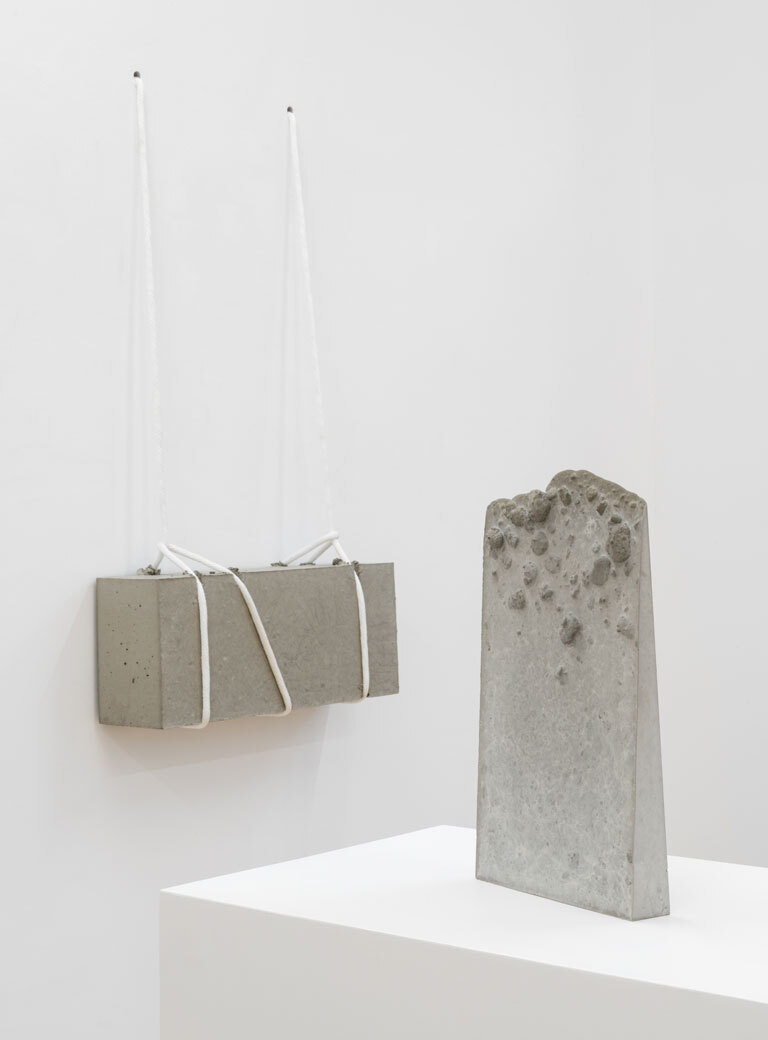
In Close Disclose, Weber inseparably combines precise shaping and what is formed by chance in a single object. It combines a smooth and a rough side, where the seemingly contradictory qualities of concrete as a material are revealed. Close Disclose tapers upward in a wedge shape; Weber juxtaposes the precise lines on the sides with an organic, flowing line at the top. Here the material - more precisely the sand or gravel portion of the concrete - forms elevations on the surface that stand in stark contrast to the smoothness of the other side. With the title, Christoph Weber gives an indication of his artistic approach, his strategy of inclusion and disclosure, but also of the oscillation of his object between concrete shaping and lyrical flowing of the material.
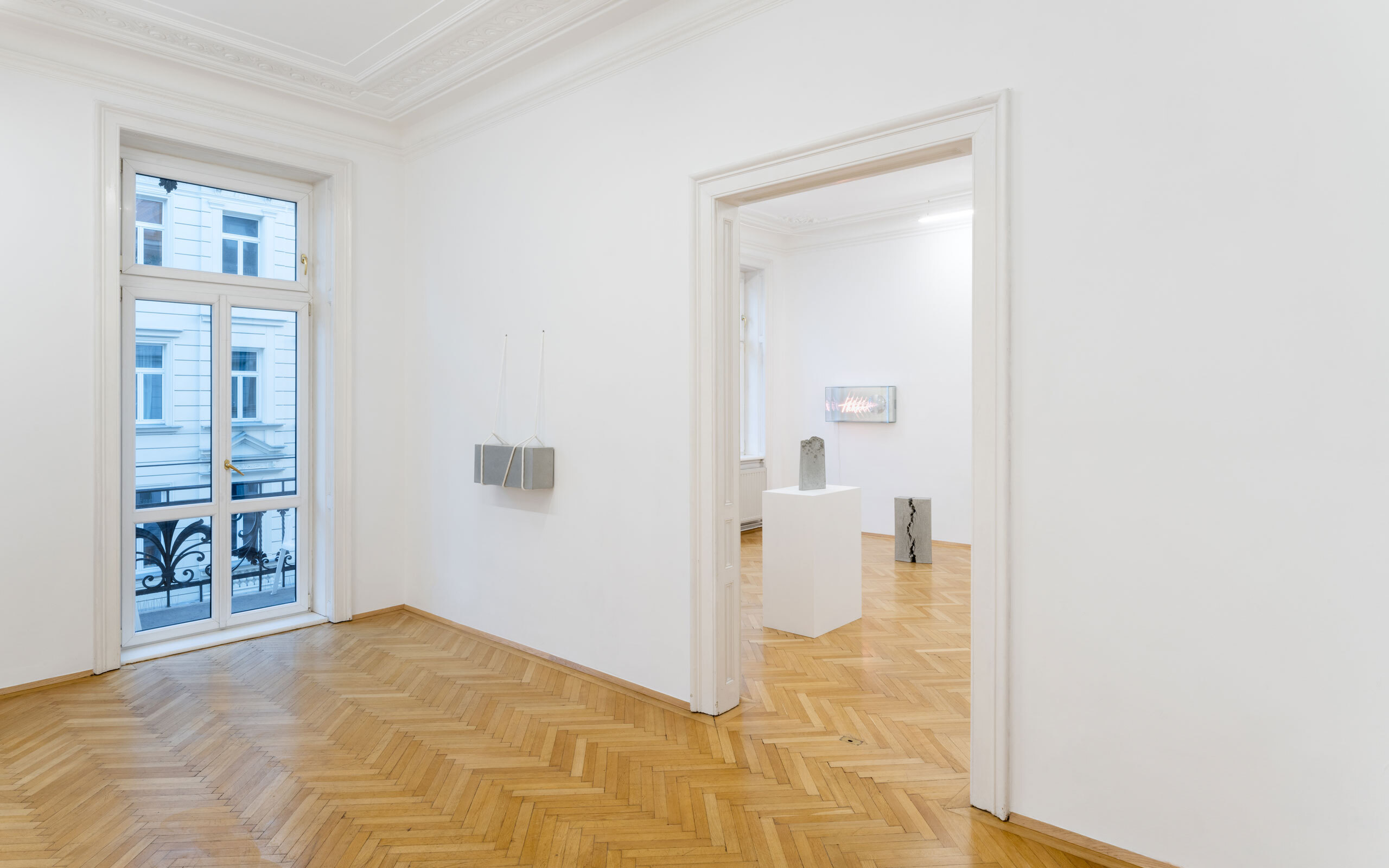
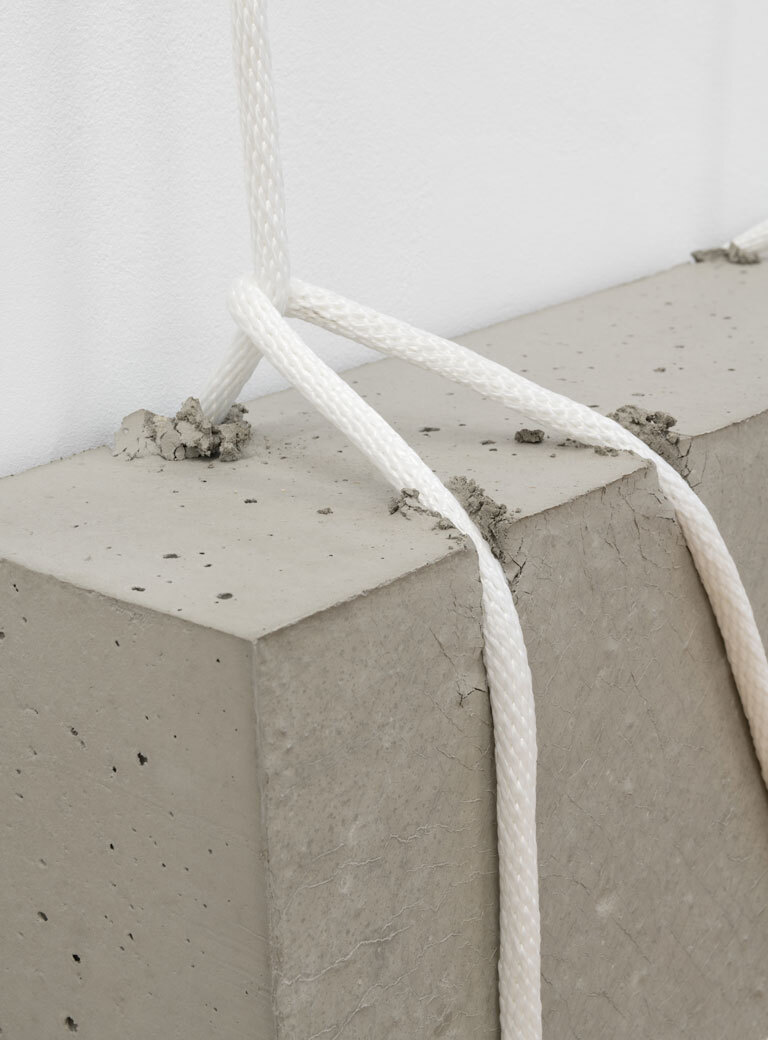
Something similar - namely the connection of two different possibilities of form - can be said for Cast & Uncast: Spatially separated, a line connects two elements to form an inseparable unit. Across a wall - and thus leading beyond the exhibition space, and building a bridge into the neighbouring exhibition - two concrete elements are connected by a rope, one of them showing clear traces of the effect of gravity on the object, while the other remains perfect in its geometric form and thus seemingly untouched. Mass and volume are clearly revealed - and yet both elements float above the ground, threaded through the wall by the artist in a paradoxical gesture.
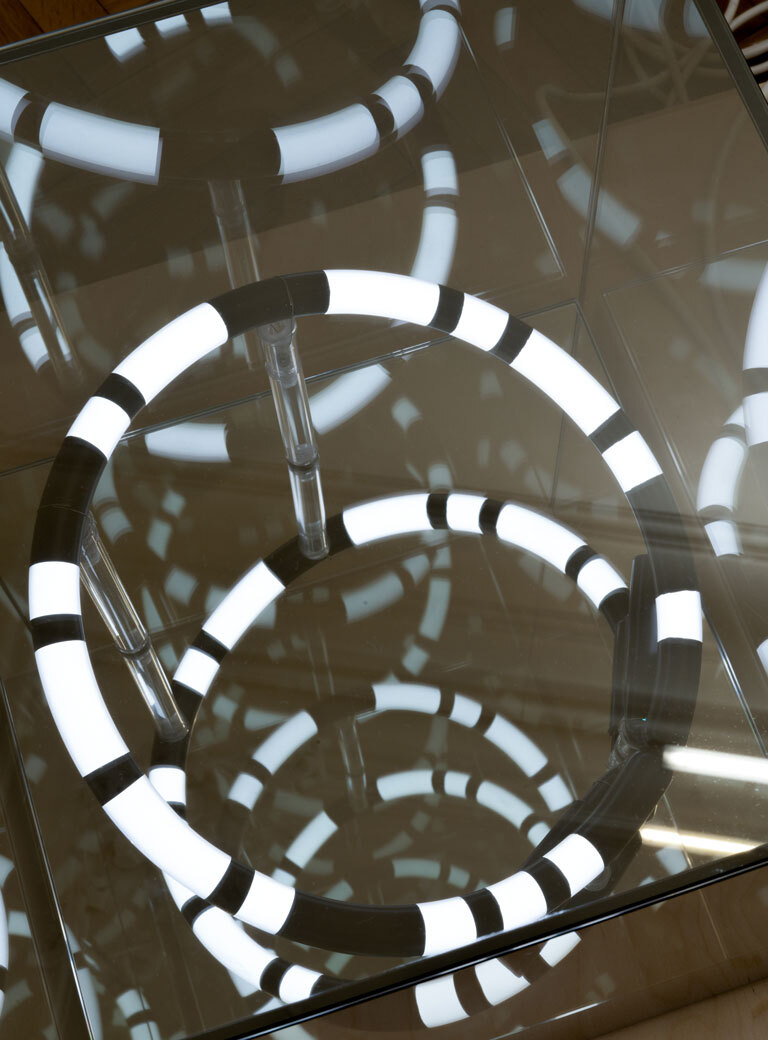
Collectors Agenda is bringing together Brigitte Kowanz and Christoph Weber in one exhibition for the first time. The encounter is based on the observation that both use a minimalist mode of expression that is strongly conceived in terms of materiality. In this dialogue, what separates the two positions becomes illuminating. Weber's limited, clearly defined forms meet Kowanz's oscillating lines, whose delimited "material" light expands in space and makes the surfaces of the sculptures with their cracks and smoothness perceptible in the first place. The "divided space" therefore does not allude to a division of space in the sense of separation, but is to be understood more as "shared space". However, the artists do not only think of the measurable space, but beyond they allow a space of ideas to emerge. Anyone looking into Brigitte Kowanz's mirrored cubes will gaze into infinity and find themselves confronted with a word. Those who walk around Christoph Weber's sculptures will find possible associations through their haptic qualities, material properties and form solutions.
The unbounded work of art, which is only completed through the interaction of the audience, demands a resonance space in which it is processed and classified. In the exhibition Geteilter Raum (Divided Space), a paradoxical field of tension of opposites and similarities in terms of materials and concepts opens up, which is capable of filling this resonance space. As if in gratitude for this, the wall simply reads luminously: "thx".
The exhibition is kindly supported by the representing galleries of Brigitte Kowanz and Christoph Weber – Galerie Krinzinger, nächst St. Stephan Rosemarie Schwarzwälder and Galerie Jocelyn Wolff.
Text: Alexandra Matzner