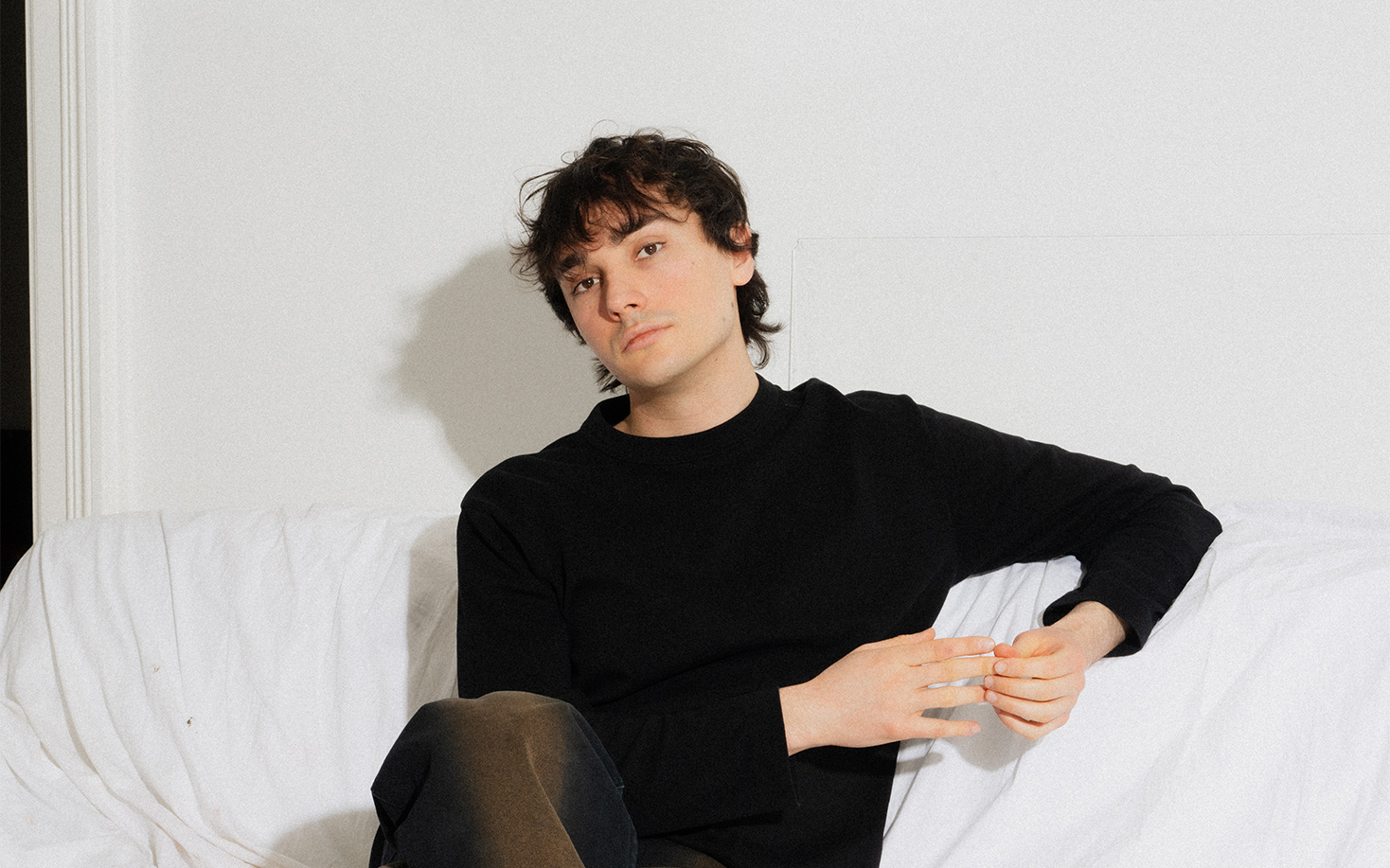
Marc Henry’s painterly worlds, presented on coarse canvas, are hallucinogenic and enigmatic. Henry uses digital images created on a computer as sketches for his analogue works, through which he explores reality in a post-factual age. Before graduating from the Academy of Fine Arts Vienna, he studied economics and curation – a background that feeds directly into his reflections on the entanglement of society and the economy.
Marc, how did you get into art?
Looking back, making things with my hands has always been instinctive – since childhood, really. Knitting, embroidery, all of that. And somehow that same impulse eventually led me to spray cans and then to painting.
How did it all start?
I grew up in Munich in the mid-2000s, very much a Mid-’90s generation. The skate park as social nucleus, not much else on offer. You skated or you sprayed, and since I had no talent whatsoever on a board, graffiti was the natural path. Because of that humiliation, I still despise skaters to this day. (laughs) Eventually it started to bother me that the work kept getting buffed, so I moved to canvas – acrylics first, then oils. Besides, my mum had always taken me to museums, so the fine art pull was there from early on.
What did you spray?
Figurative narratives with text – the two were always intertwined. There was a period that felt almost like Jenny Holzer territory: paintings with captions, truisms. That dialogue between word and image has stayed with me ever since; to this day I consider the title an integral part of the work.
Did you study art after leaving school?
No, it just wasn’t in the picture. I had no frame of reference for art as a profession; I’d never seen anyone actually do it. I studied economics in Munich and Stockholm, which felt like the obvious path – something respectable, as my parents would have put it. They hadn’t studied themselves, so it was important to them. But it genuinely suited me too; I’ve always been drawn to the intersections of economics, politics and society. And then in Stockholm, alongside my studies, I rented a studio and started putting together my portfolio for the Academy of Fine Arts in Vienna.
Why Vienna, specifically?
Daniel Richter was the reason. He’d been a hero of mine since I was a teenager – partly because of his background in music and visual culture, but also that post-punk attitude and aesthetic. Coming from graffiti, with all its political charge, that resonance was immediate.
Were you accepted straight away?
Yes, we had a great interview – I still remember it well. Looking back, though, I’m honestly still a little surprised he took me.
Maybe your portfolio was just that convincing?
Above all, it was designed with meticulous attention to detail – everything beautifully taped down, with passe-partouts for the pictures. (laughs)
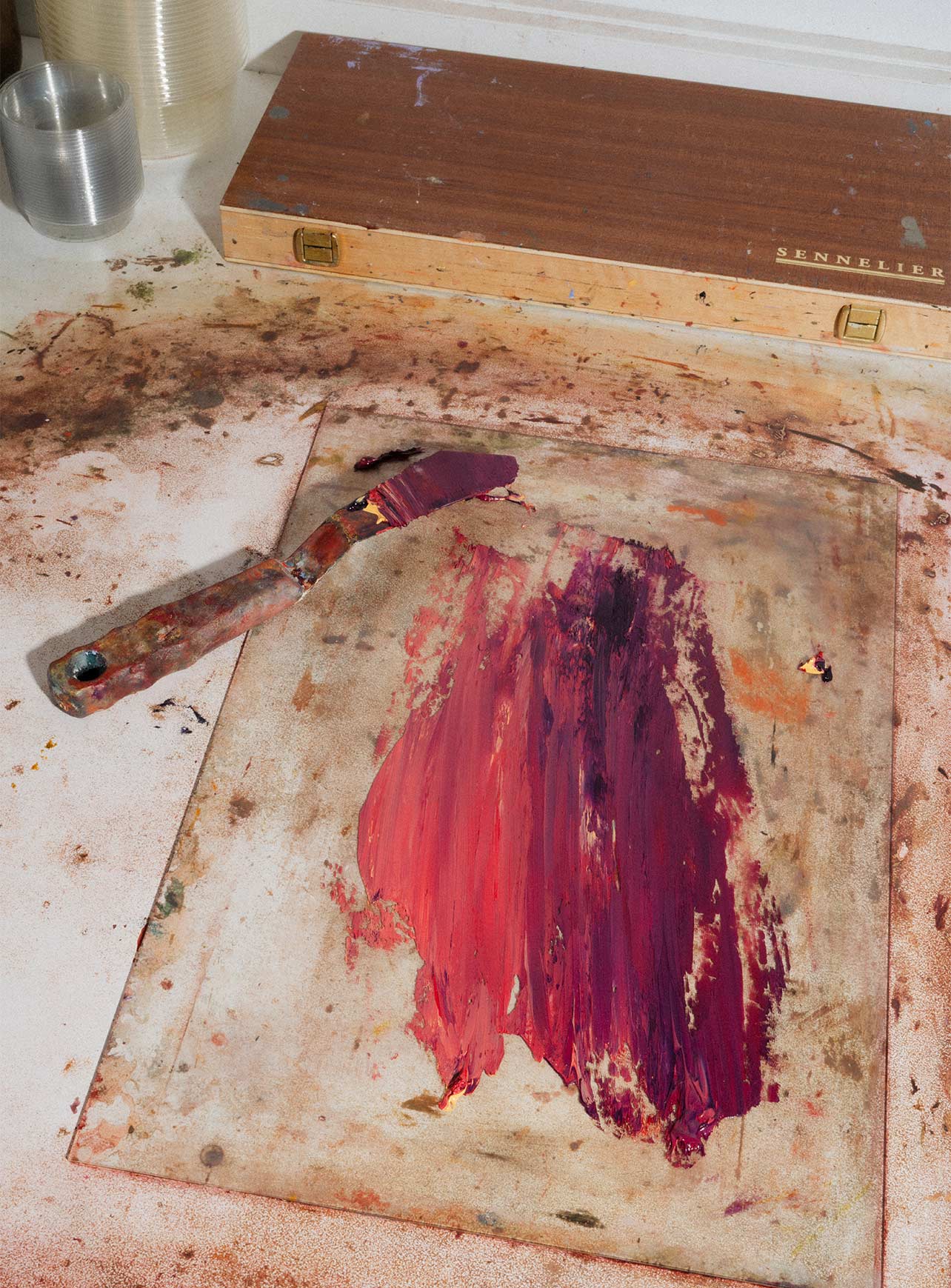
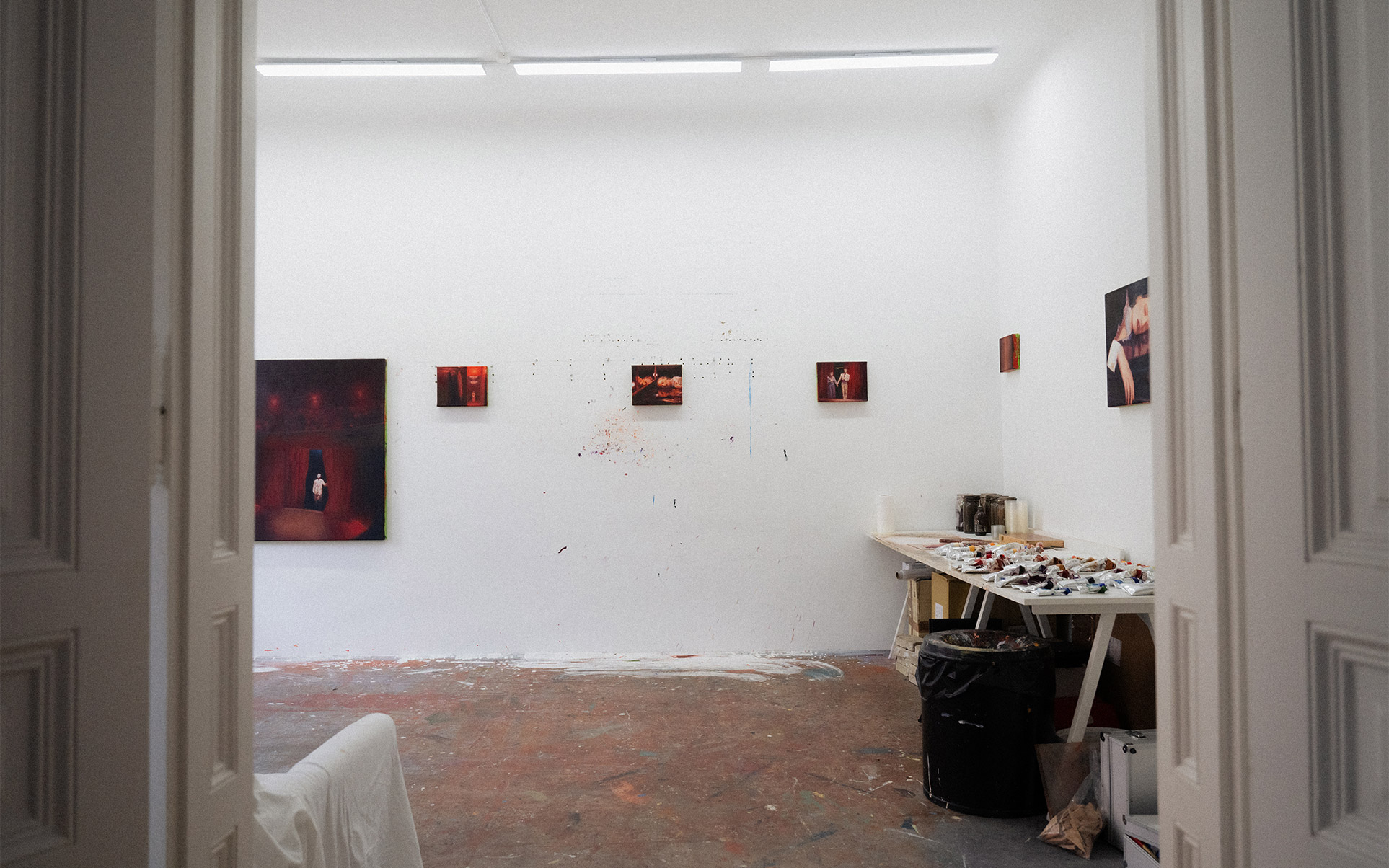
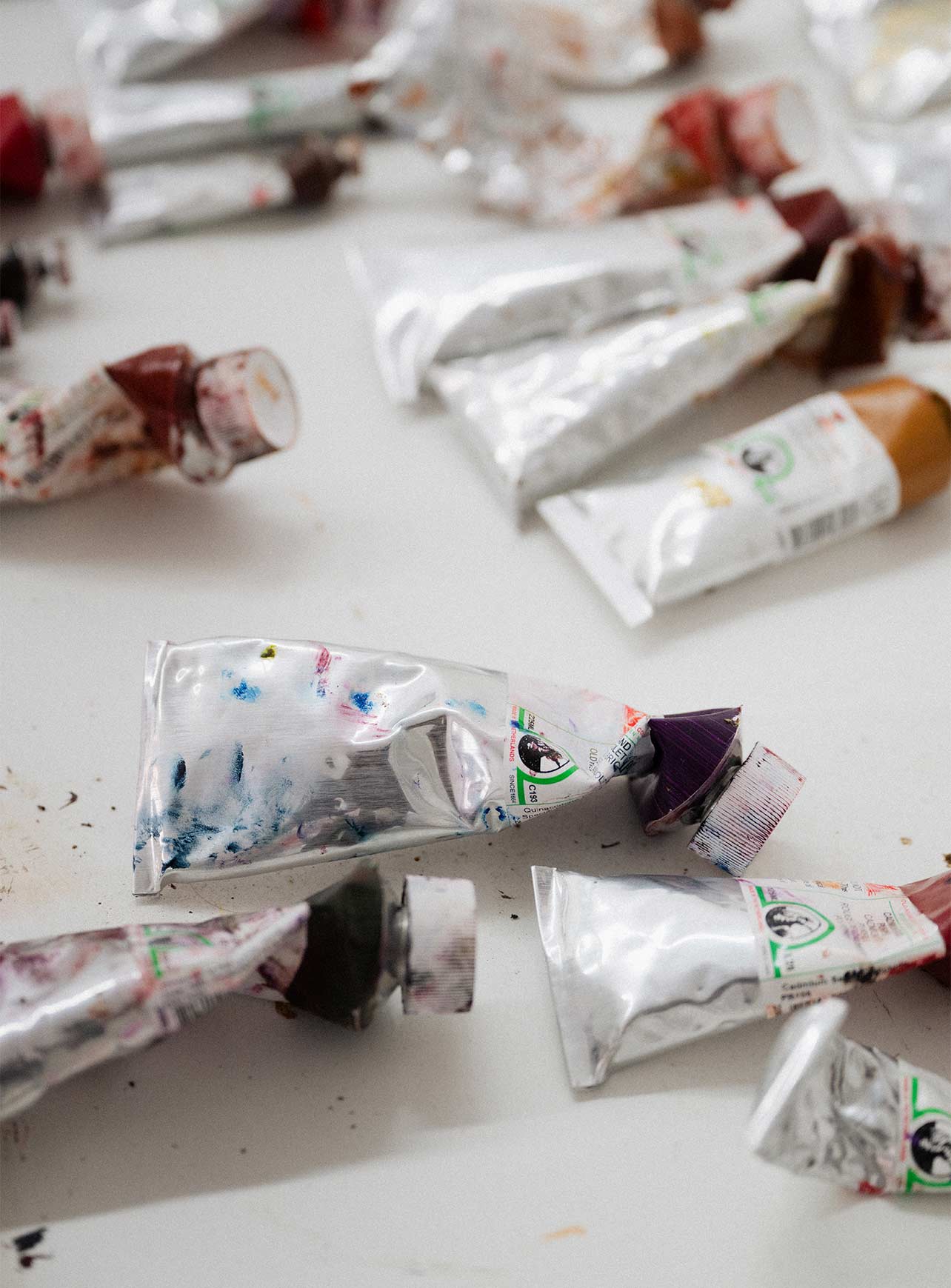
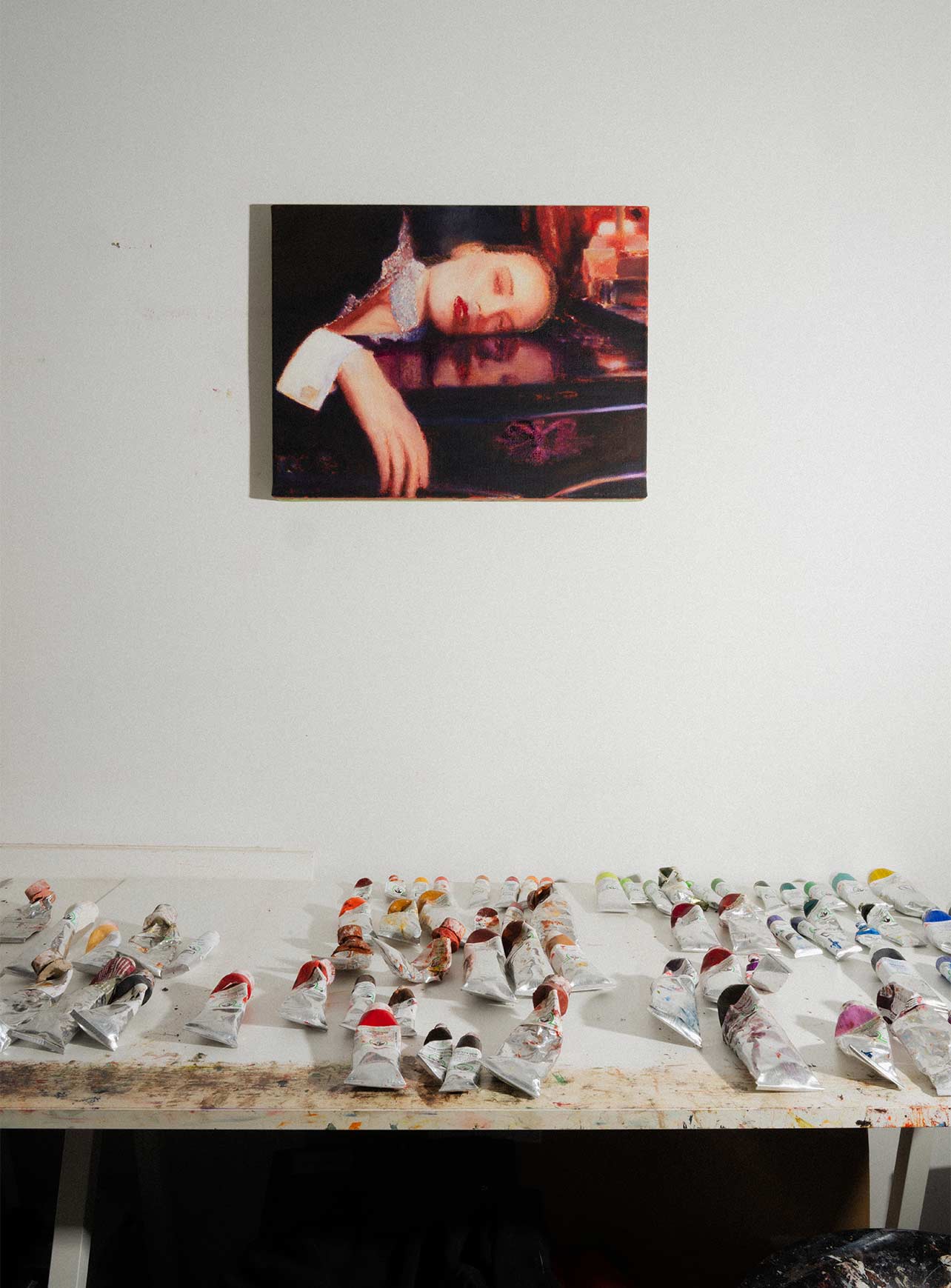
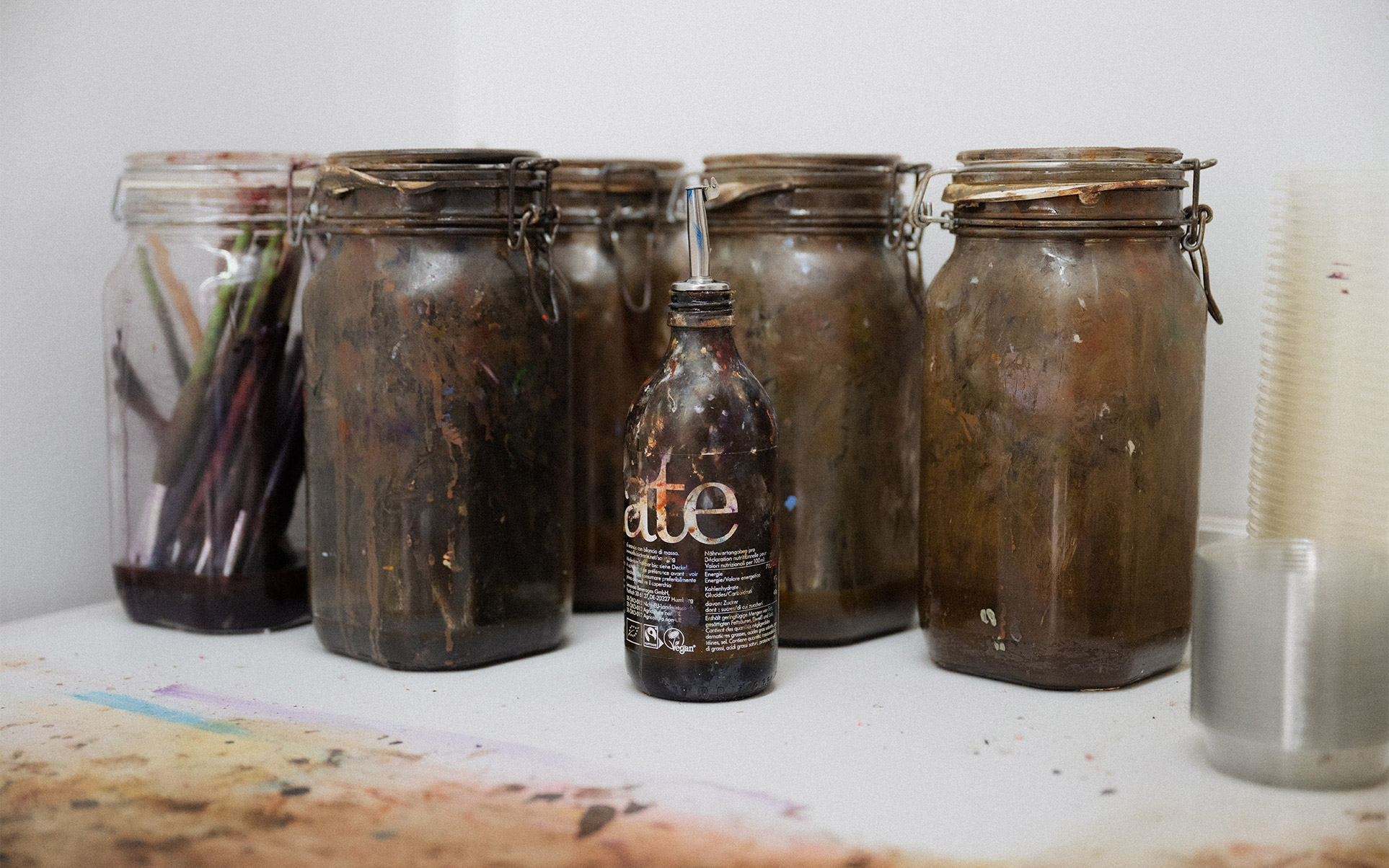
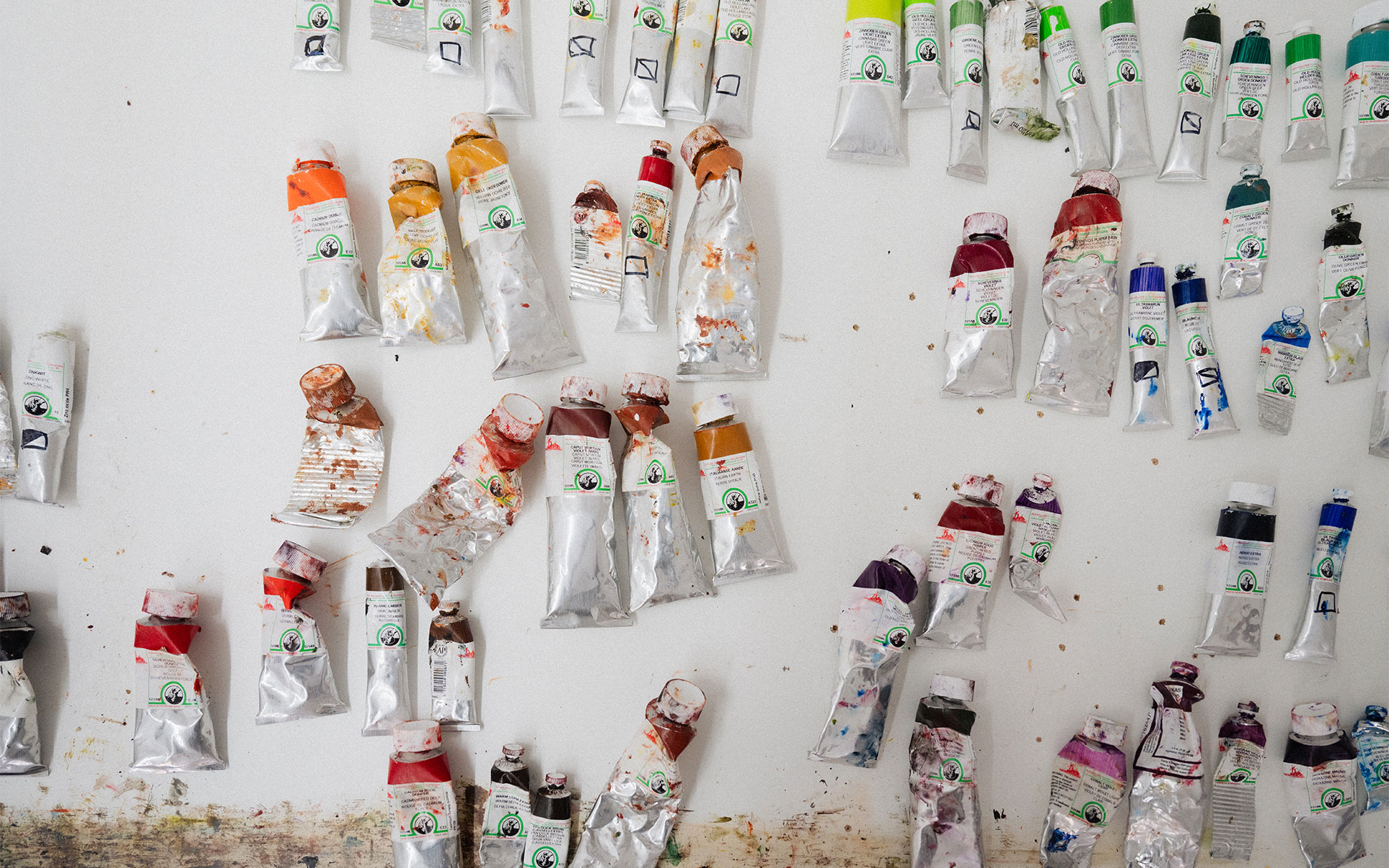
Everything’s very tidy here too; the paint tubes are all lined up in rows…
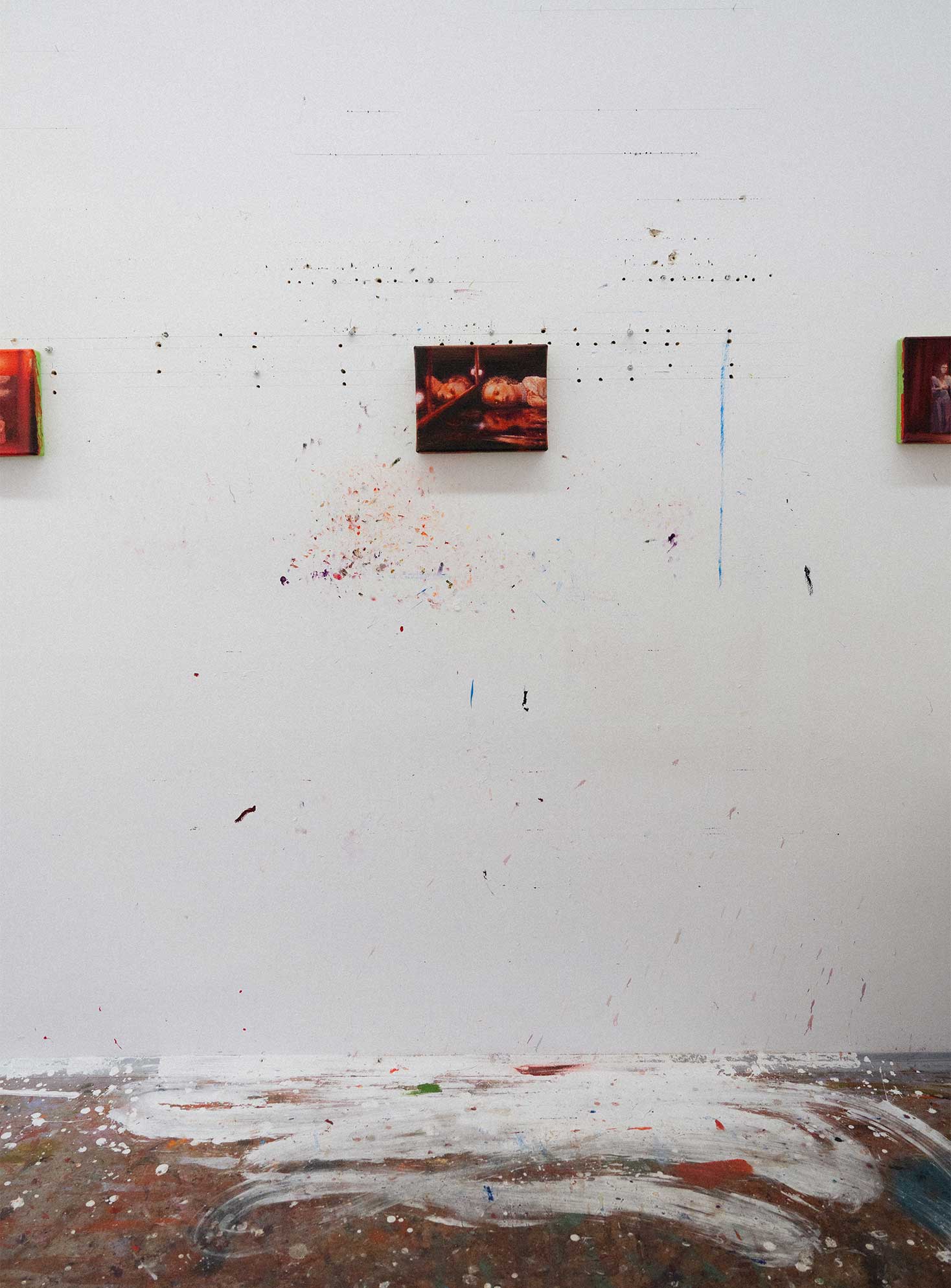
Yes, that’s important to me. I can’t work if my tools aren’t ready. (laughs)
With such a neat presentation, you might have stood out from the crowd…
Definitely – but Richter probably didn’t find that particularly appealing. We didn’t actually talk about my portfolio at all, but about De Kooning. About how he painted his best works when he already had Alzheimer’s. And Richter found that rather curious and accepted me. I graduated in 2023.
How did you find a gallery afterwards?
Through a combination of things, really. Being present at the Academy’s open days, showing with our class – but the exhibition projects I initiated independently carried at least as much weight. I joined Galerie Kandlhofer six months before I graduated, which felt like a real turning point.
What advice would you give to younger artists looking to get into a gallery?
The work has to be right first – throughout my studies I tried to develop something that felt sustainable to me. After that, it’s about having the right people around at the right moments. Beyond that, I took a huge risk, put everything on one card, and just kept getting lucky.
In what way?
In moments when my bank account was three times overdrawn, someone would suddenly buy two paintings. I believe you have to carve out your own position, regardless of market feedback. For example, I often heard early on that my pictures were too gloomy for anyone to ever like them – or to hang them at home and live with them day in, day out. But you have to develop something that interests and challenges you personally.
What is your working process like?
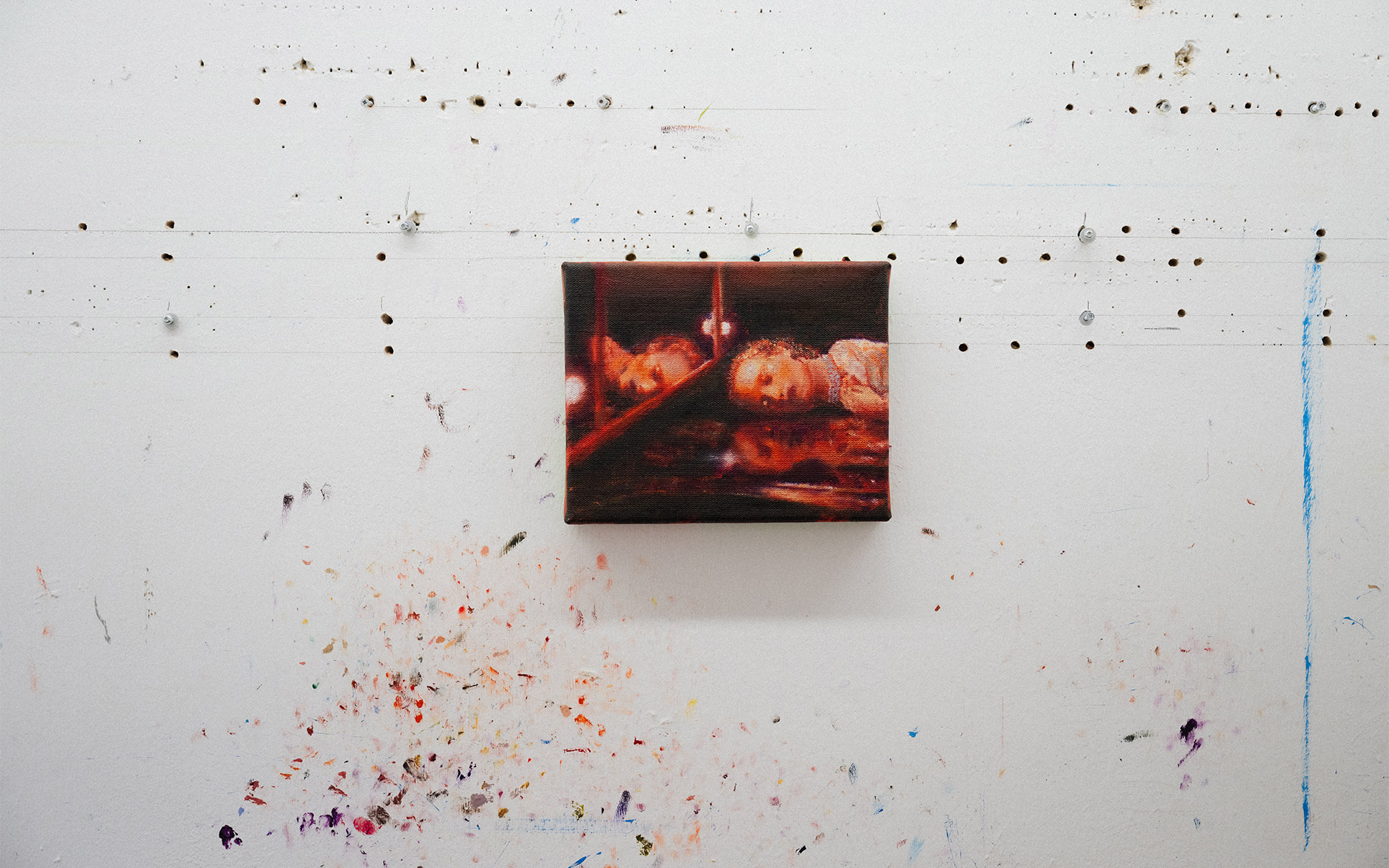
A significant part of it is digital. The image-finding process is rooted in digital visual worlds – I’m interested in media landscapes, in how images are manipulated and cropped, how they circulate. Over the years I’ve built up quite an extensive archive of photographs that I draw from. From that I create Photoshop collages on my laptop, mixing found material with my own photographs.
How do you use these collages?
Just as sketches, really. I print them out and hang them in the studio next to my workspace, but I only glance at them out of the corner of my eye. It’s becoming increasingly important to me to dig into materiality. I want to move away from the digital and into the analogue – but what perhaps shows subconsciously in the images is that they’re constructed according to classical rules of painting, and also consciously break with them.
Is respecting traditional techniques and bringing them into the present a thread running through your work?
Yes, absolutely. I believe an awareness of craft is very important. You have to know theory and practice in order to break with them. I get the feeling that mistakes are often made in painting. Beuys did say, “The mistake begins the moment one sets out to buy a stretcher and canvas”. (laughs) He meant it differently, of course, but there’s a bit of truth in it.
Speaking of craft: do you paint quickly?
The first draft is quite quick – within a ten-hour working day – and then I decide whether to keep the painting or let it go. If I keep it, I work on the details for weeks and weeks.
What inspires you?
I find moments particularly fascinating where it’s no longer entirely clear whether you’re interpreting something as a memory, a staged scene or reality. For me, this often develops into a speculative narrative that has a lot to do with fabricated memory and the post-truth era. At the same time, political and social circumstances also feed into the work. I try to revisit these main themes anew for every exhibition project.
Can you give me an example?
This autumn I’m opening my first institutional solo exhibition at the Neuer Aachener Kunstverein. The starting point is the question of how malleable reality has become in the post-truth era – and how that can be translated into a spatial dramaturgy. One key reference is Johannes Kepler’s Somnium written around 1608, which already shows that fiction can not only generate insight but also serve as a projection screen for conspiracies. What interests me is how that historical constellation maps onto the present – onto media landscapes where facts, speculation, emotion and image production increasingly blur, and where conspiracy narratives often operate with the aesthetic of evidence and apparent logic.
And what about the technique?
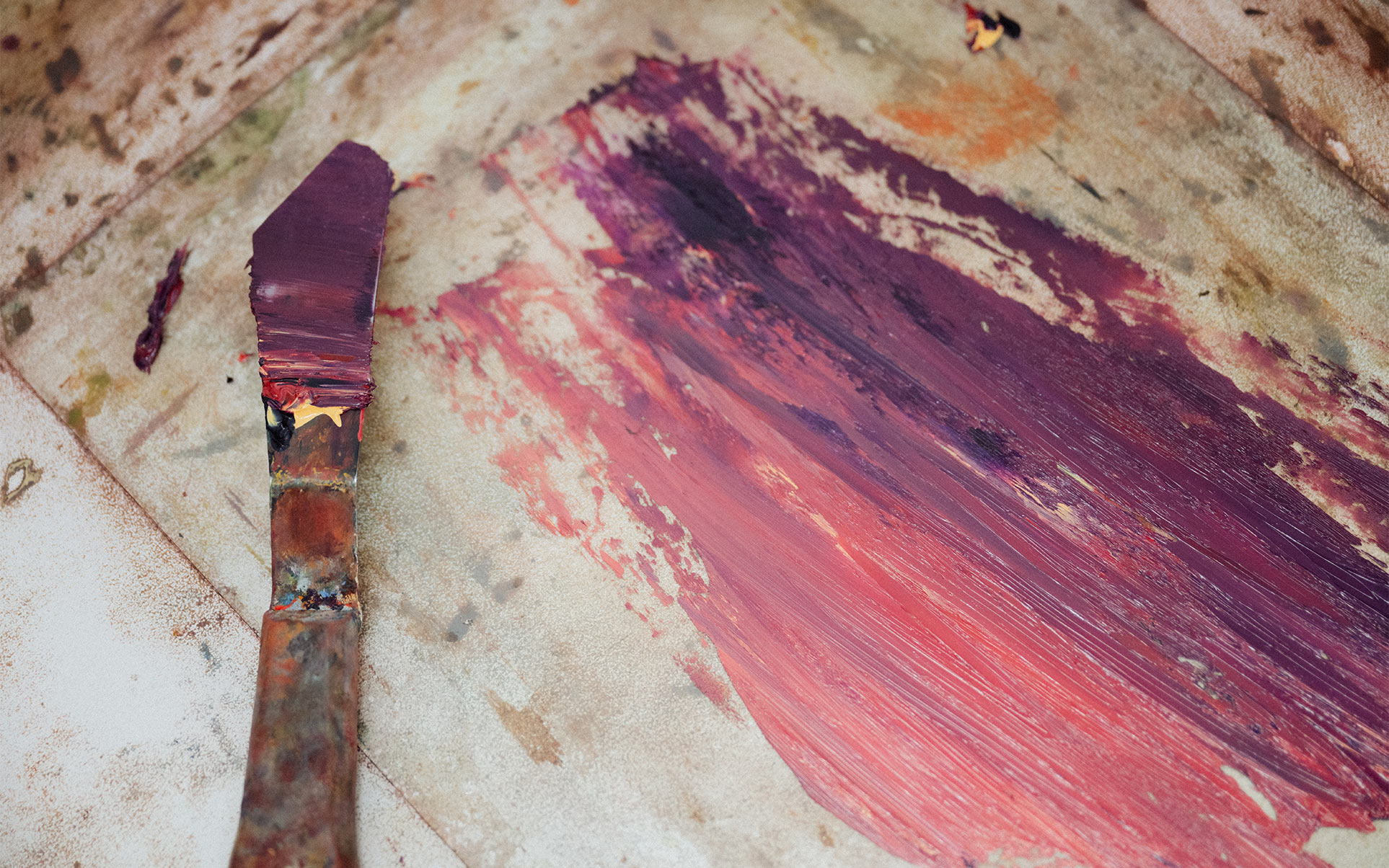
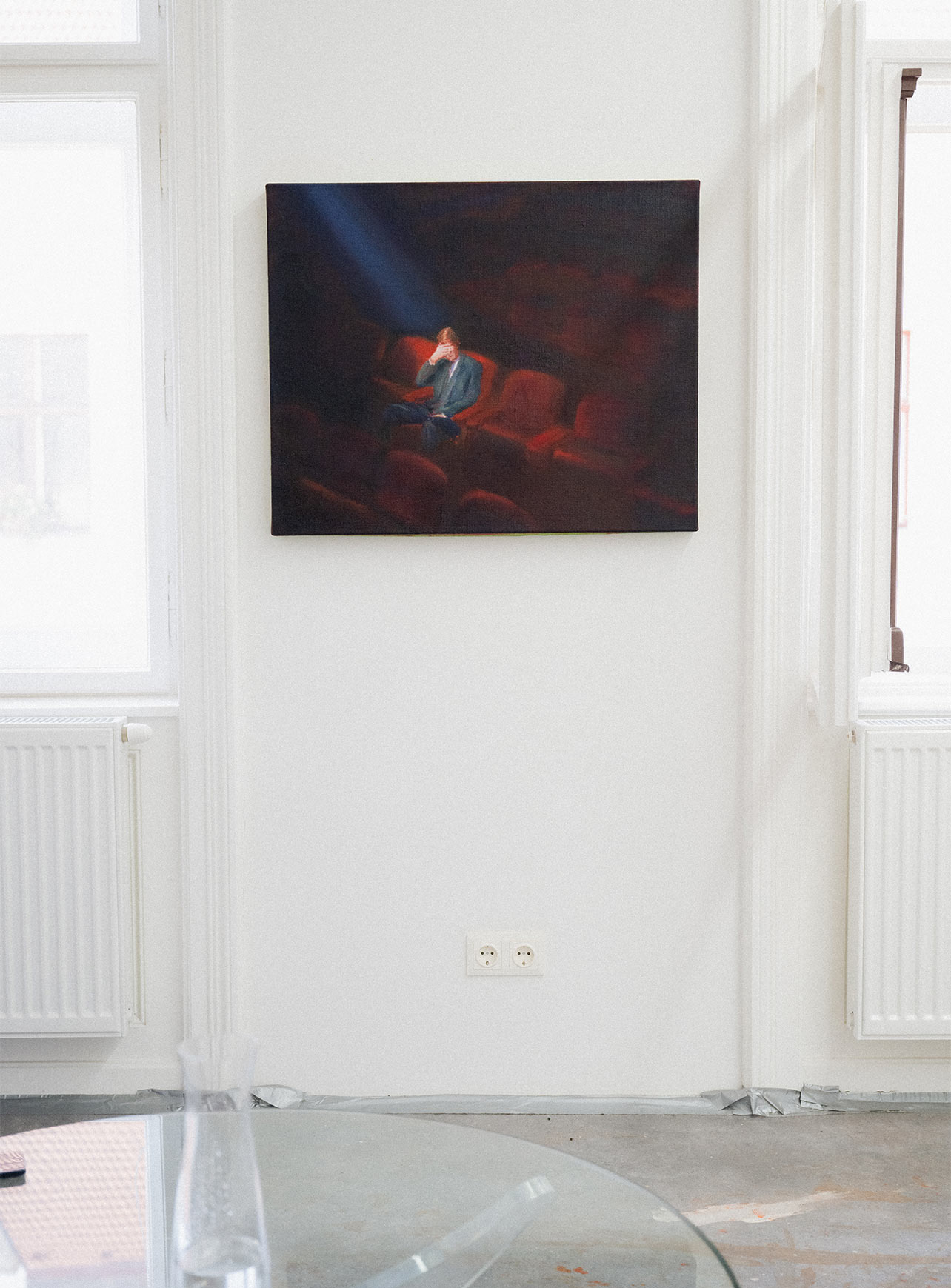
The emotional topography of film noir runs through everything – the motifs, but also the way I actually paint. I work on very coarse canvas and scrape back the layers repeatedly; the canvas structure pushes through the paint and creates this grain, almost like the texture of analogue film.
The interiors that emerge sometimes look as if they’re from the 1950s?
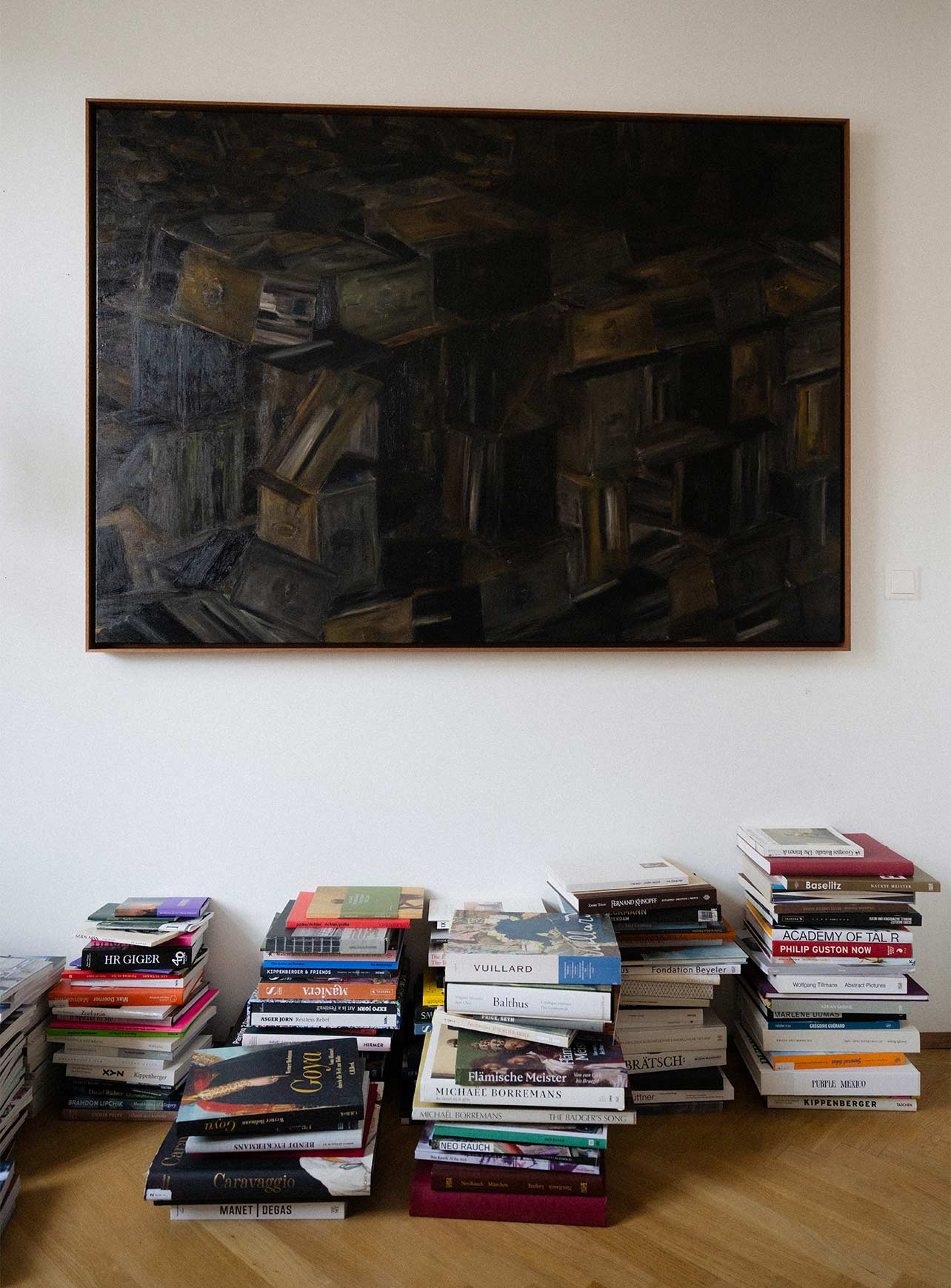
What interests me fundamentally is painting pictures that feel contemporary, or at least present themselves as such – but I want to make the present legible without the shortcut of simply dropping an iPhone into the scene, à la Nicole Eisenman. That kind of literal anchoring doesn’t interest me. The present should be readable in the work, but so should these temporal axes that leave you genuinely uncertain – whether it could just as easily be fifty years in the past, or somewhere still in the future.
From time to narrative: what do your paintings tell us?
For me, it’s absolutely crucial that viewers come up with their own story when seeing an exhibition. I think a good exhibition sets out the cornerstones, and the visitors write the chapters themselves. I want to introduce a certain narrative, but I believe that’s only part of the truth.
You spoke of reality in the post-truth era: what is reality for you?
Interestingly, in painting in particular, the oil painting still has something factual about it. It captures something across time – at least that is the idea. You can capture a fiction and thereby validate it. That is what I find so compelling about the medium.
Because we trust the image?
Yes – even now, in the age of AI and Photoshop. And it’s not as though manipulation is a recent invention; the darkroom was already full of possibilities. What I find astonishing is how stubbornly the image holds onto its claim to truth.
Do you observe your own generation through your work?
To some extent, yes. The social reality I depict is rooted in observations of my own generation. I’m about to turn thirty, and ours is a generation that came of age in a highly politicised moment. What I sense now is a retreat – a turning inward, back to the private.
The domesticated generation? The new Biedermeier?
Yes, I do think that’s partly true.
And you’re making art about it?
It’s one aspect that’s on my mind in some way. I don’t necessarily want to depict my generation, but I do want to engage with it.
How much does your background in economics still influence your work?
Quite directly, in some cases. Last year’s exhibition in Berlin, The Theory of the Leisure Class, was built around it – the title comes from Thorstein Veblen, an early sociologist and economist I first encountered during my studies. The book deals with the prestige-generating function of consumption and finding a way to reinterpret and reframe that through painting was something I found genuinely compelling.
Would you say your work is generally critical of consumerism?
No, and I certainly don’t make political art. But my work does express a certain personal perspective on society, which in turn is shaped by a certain perspective on the economy. In many respects, we are currently living in a very existentialist era. My friend Timotheus Überall wrote the following sentence about a character in his novel Crazy Land: “As if the Lord had only just cast him into the world.” That fits my protagonists perfectly.
Speaking of writers – your titles are also extraordinary.
The idea of text is important because you can add a layer of meaning, or lead people astray. That’s why image titles matter, and I find it rather lazy when artists can’t come up with any.
Do you spend a long time working on your titles?
Sometimes a title exists long before the painting does – then I just have to paint it. (laughs) And sometimes it’s the complete opposite: a work is literally about to be collected and I still need to name ten pieces on the spot. I keep a running list, though – notes on my iPhone, potential titles, thoughts as they come. That helps.
You named one painting Looking for Fun – though it actually showed a lonely security guard in the snow. Where do you yourself look for fun? Judging by the overall mood of your work, probably not in the paintings?
Yes, I do have a lot of fun with the paintings – that is, painting them. But I’m probably also a melancholic person, though more in the Dürer-ian sense. My paintings have a certain twist, a different, playful layer; they are only melancholic at first glance. I don’t perceive them as gloomy – and I don’t understand at all why people sometimes think they’re murder scenes. I think they’re quite jolly. (laughs)
You depict people, but also nature. Is 19th-century Romanticism an inspiration?
In my paintings, nature stands in contrast to the highly artificial worlds – or rather the business worlds, the engine rooms of capitalism. So I place a domesticated metaphor for nature – flowers in a vase, for example – within a business interior. Or a cypress tree in a museum display.
Does the contrast between artificiality and nature appeal to you?
I’m interested in turning the concept of German Romanticism in painting on its head. Take Caspar David Friedrich, for instance, where man subjugates nature. In my work it’s the opposite – you can’t actually see beyond the nearest tree. That’s a metaphor for the limits of human knowledge.
What are your next projects?
In April I have a residency at Palazzo Monti in Brescia, after which I’ll be presenting my first monograph in Venice. Then comes Liste Art Basel with the Berlin gallery Anton Janizewski. In September I’ll first be doing a group show with Lisa Kandlhofer at Frieze Seoul and then, as mentioned, my first institutional exhibition at the Neuer Aachener Kunstverein.
That sounds like a lot of work. Do you still get round to painting?
At the moment I’m painting six days a week, from ten in the morning until midnight.
What do you think of living and working in Vienna?
I feel really at home here; I’ve been here for quite a while now. It’s one of the few cities where being an artist is still economically viable, and with the Academy and the University of Applied Arts, there’s a real infrastructure for developing a serious artistic practice. That combination of affordability and cultural density is something you don’t find easily elsewhere.
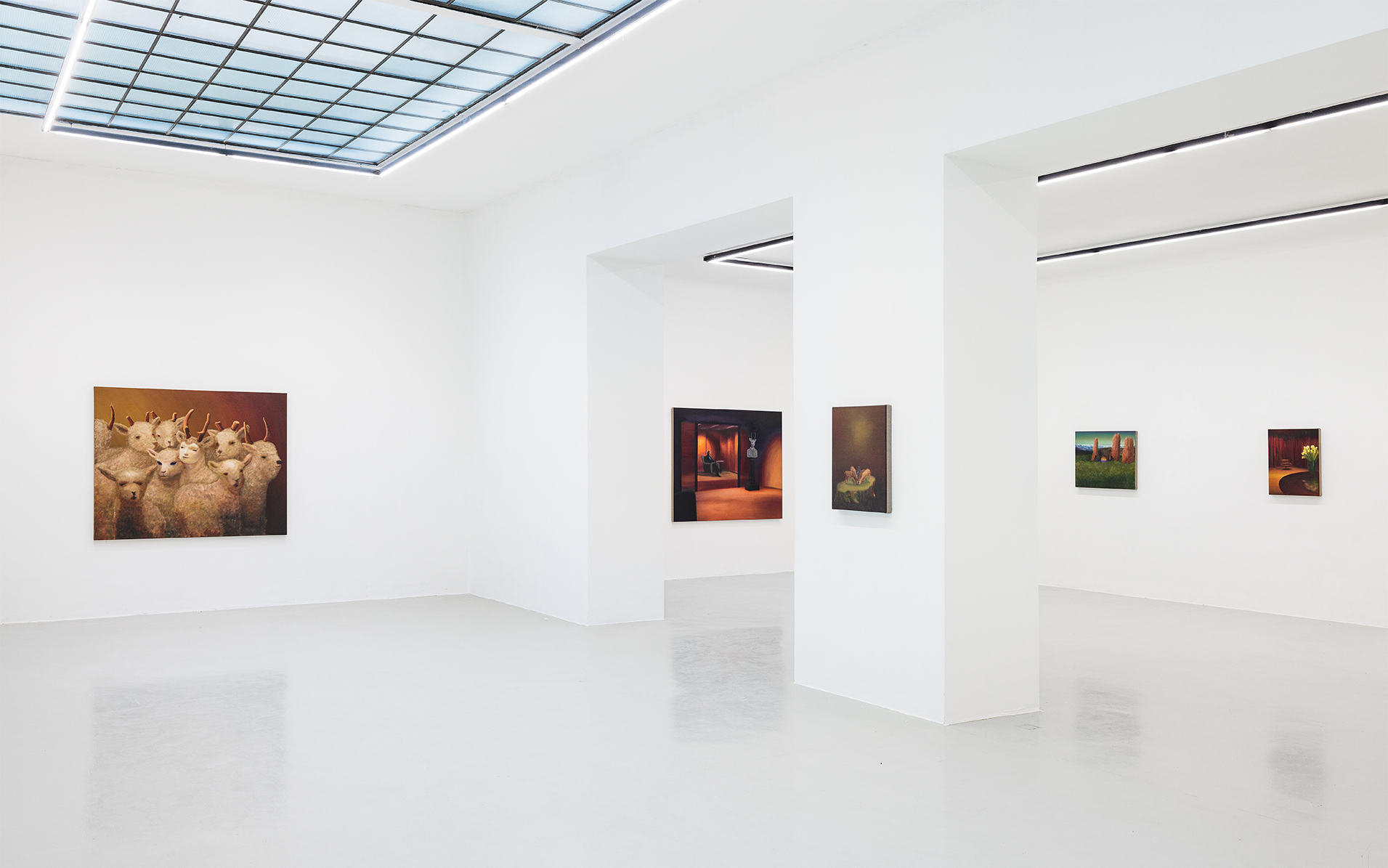
Installation view: “Field Trip”, Galerie Kandlhofer, 2025. Photo: Manuel Correon Lopez
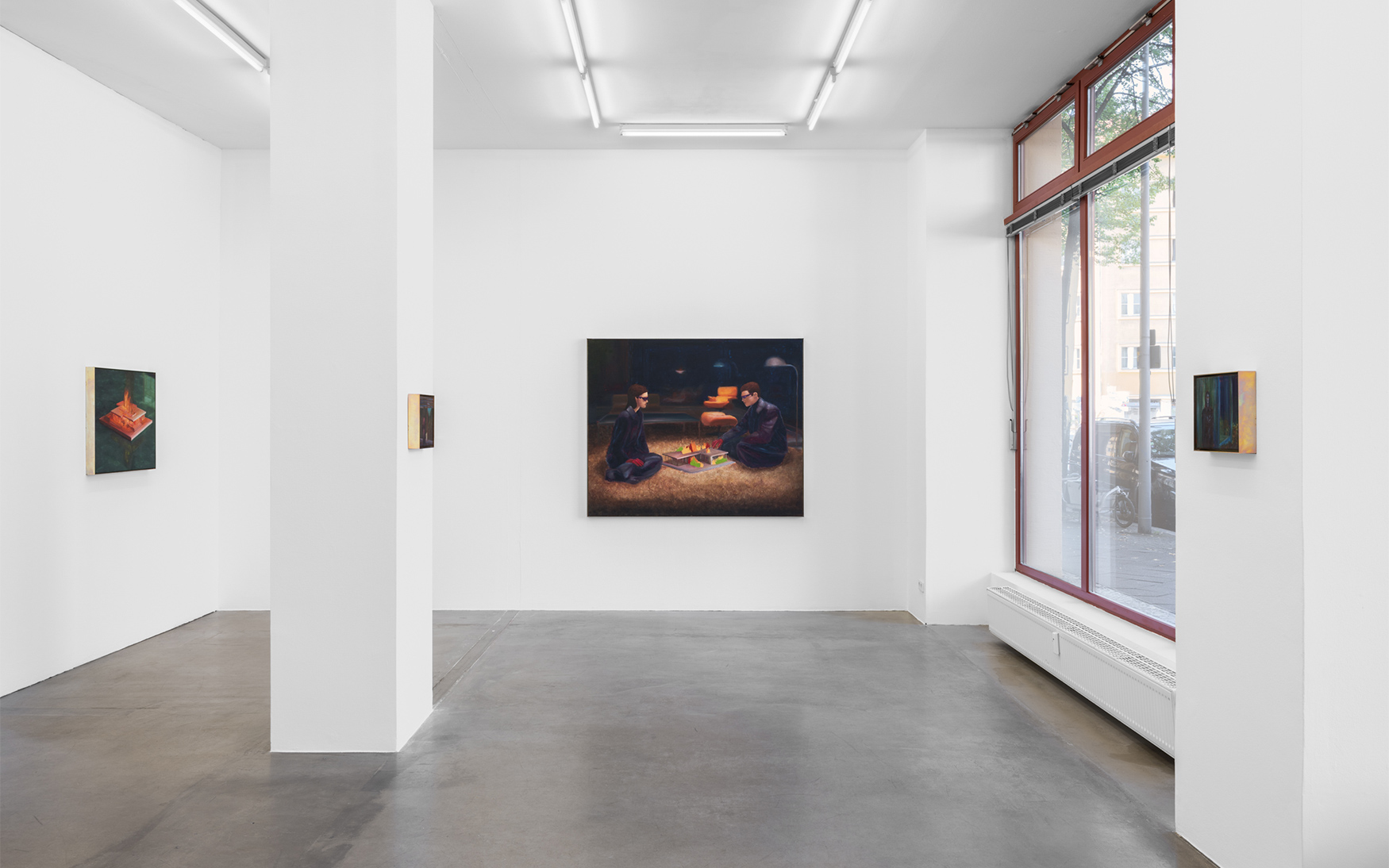
Installation view: “Theory of the Fine People”, Anton Janizewski, 2025. Photo: Julian Blum
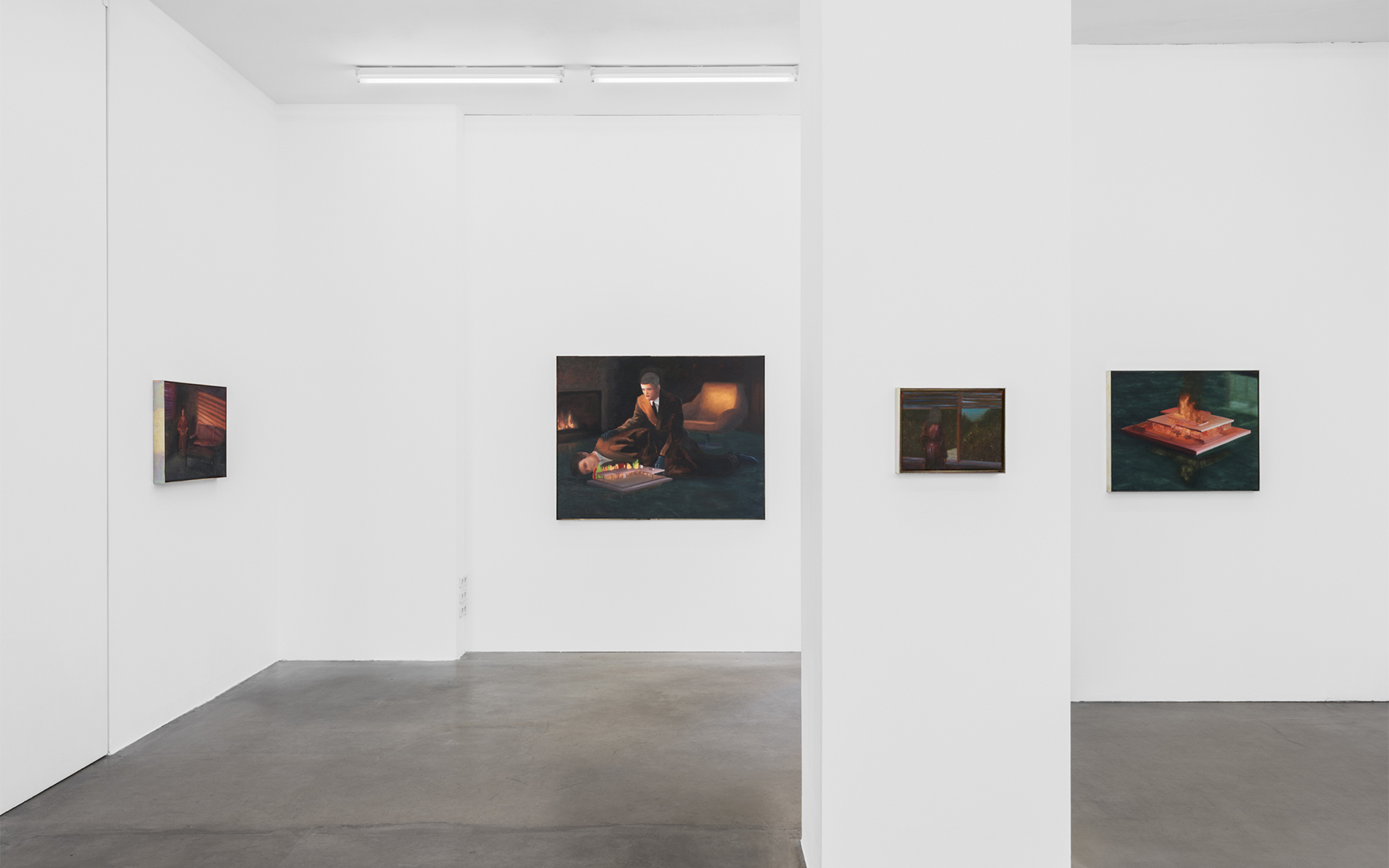
Installation view: “Theory of the Fine People”, Anton Janizewski, 2025. Photo: Julian Blum
Text: Alexandra Markl
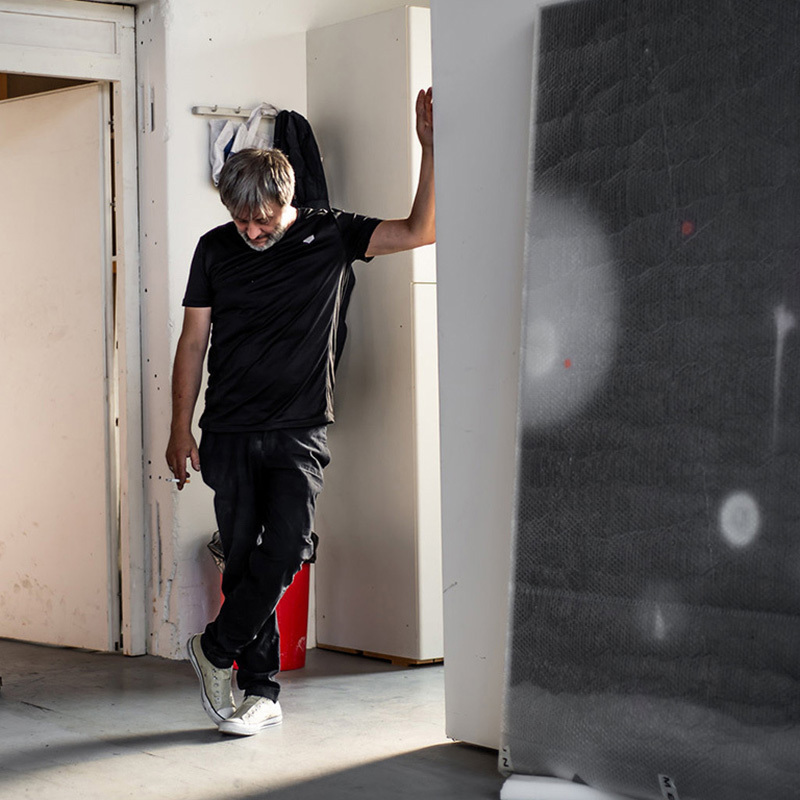
Photo: Christoph Liebentritt