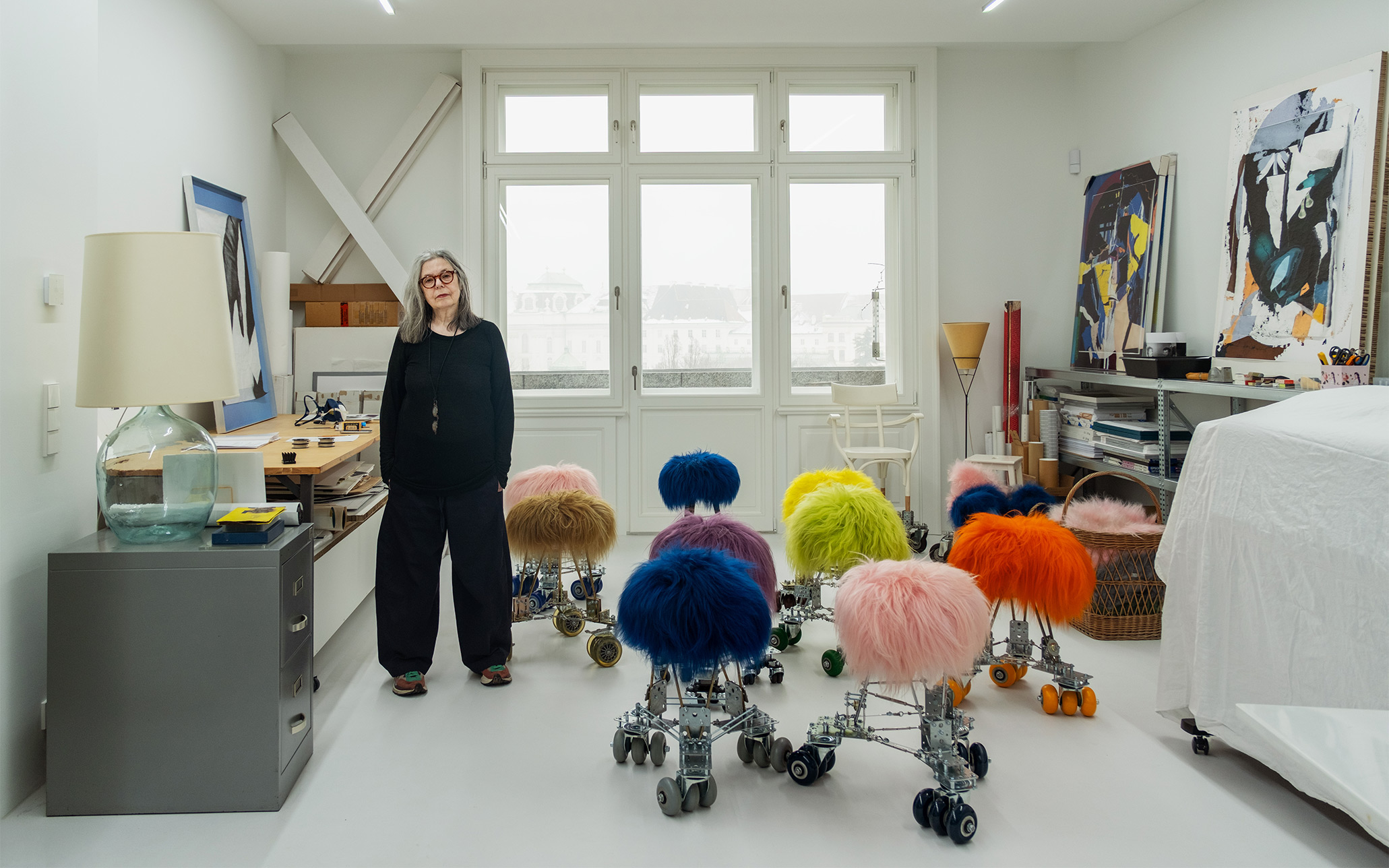
Austrian artist Marina Faust began her career in photography. In addition to commissioned work, she already showed her unique view of the world in the 1980s with works such as Miniatures. Her work combines the planned and the playful, always starting with the object, the “objet trouvé” (found object), which she transforms into rolling armchairs or eclectic chandeliers. In addition, Faust photographed for fashion designer Martin Margiela and Interior Magazine for many years.
Marina, what brought you to art?
I grew up in Vienna, surrounded by art - my mother ran an open house and artists, philosophers, and writers were always around. I didn't see myself as an artist from the beginning, but the possibility was always there. I started working as a photographer at the age of 18, even though I didn't know much about it at first (laughs)! Back then, you could still get jobs - I photographed for Die Presse and Wochenpresse for two years.
Without having really learned it?
I learned everything on the job. If you don't go to school, learning may be slower and more laborious, but it works.
Have you ever regretted not having an artistic education?
No, not really. What I regret is that I missed out on school; as a child, I didn't possess the necessary concentration. Later, I learned by listening and living. That's how I caught up on mythology and history.
So you were a staff photographer at first...
Yes, only briefly, then mainly freelance. I started doing my own projects early on. To this day, I still do photo work on request from time to time.
Were your own projects more documentary in nature?
Reportage photography was and is my field. At the time, I looked for topics that interested me. My first personal body of work was about World War II bunkers on France's beaches that cannot be properly destroyed, that sink into the dunes, disappear at high tide and reappear at low tide... I found that poetic and fascinating.
And then?
I worked in Italy for many years. My subject was life around me; life and work intertwined. The Italian Renaissance impressed and inspired me deeply. Then, in 1982, I had my first exhibition at the Agathe Gaillard Gallery in Paris.
What did you show?
It was about my personal view of things. The first exhibition was called tout partout toujours (everything everywhere always). I felt that I see things that others might not see. It was an approach that was somewhat abstract, mysterious, fragmentary, creating a world of its own. There were situations, constellations, black-and-white photographs, including figures that were not necessarily recognisable, representing a mood, a state of being.
That sounds like the prehistory of many of your later works...
Yes, if you look at my development from the beginning, that's true. It all started with photography, and much of it leads back to it.
Does that also apply to the Miniatures you created from 1986 to 1989?
Exactly; for this series of self-portraits, I held the camera in one hand and photographed a gesture I made with the other hand. Incidentally, that was a big physical challenge because back then you still had to look through the camera to take a photo (laughs)! They were self-portraits in which only part of me was visible, performing an action. These were printed in the smallest format possible that the enlarger allowed. It was a glimpse into the everyday life of mundane gestures. It wasn't about recognition, but about expressing the complexity of simple moments.
This brings us to your Faces—a series of heads that oscillate between collage, photography, painting, and drawing...
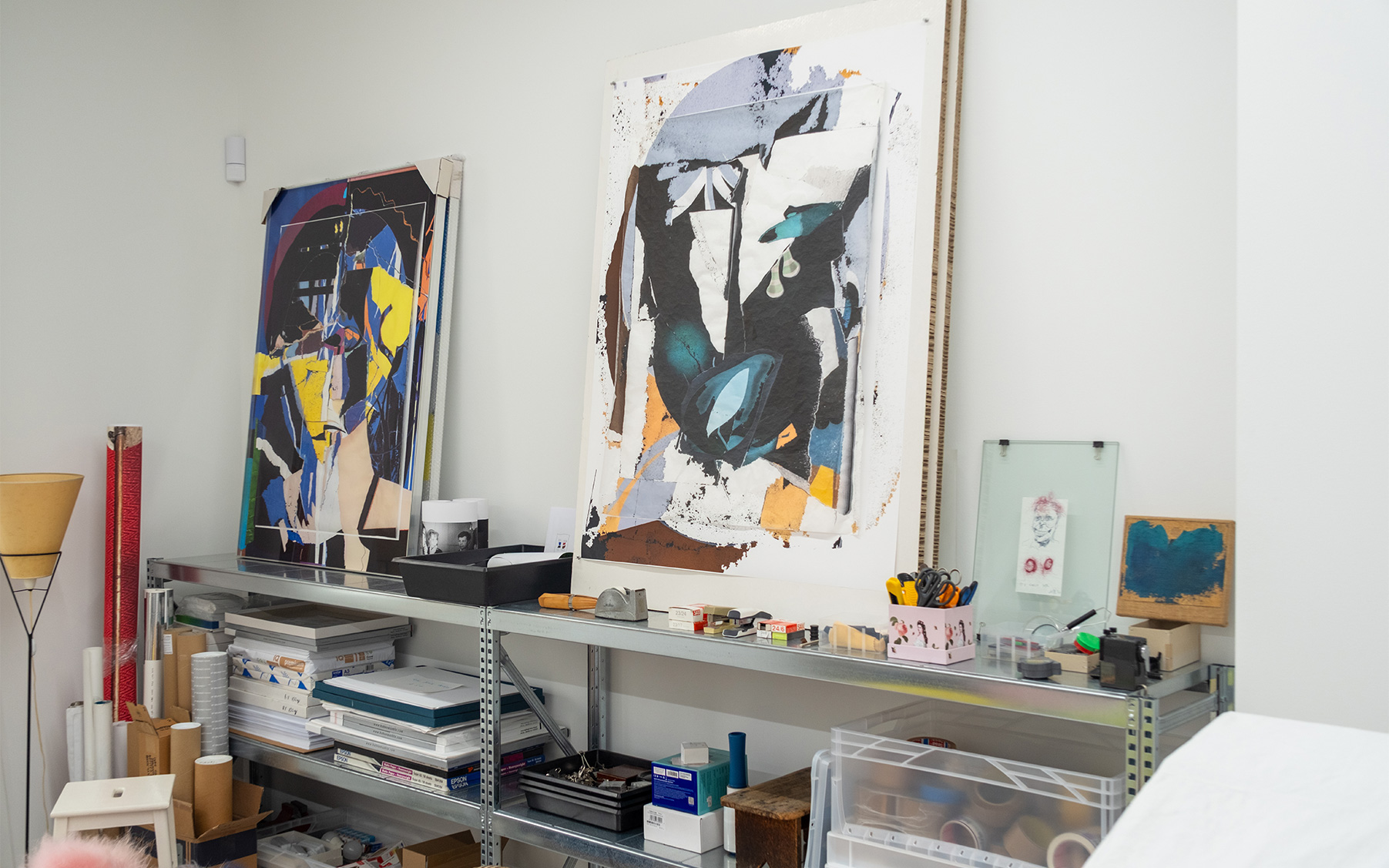
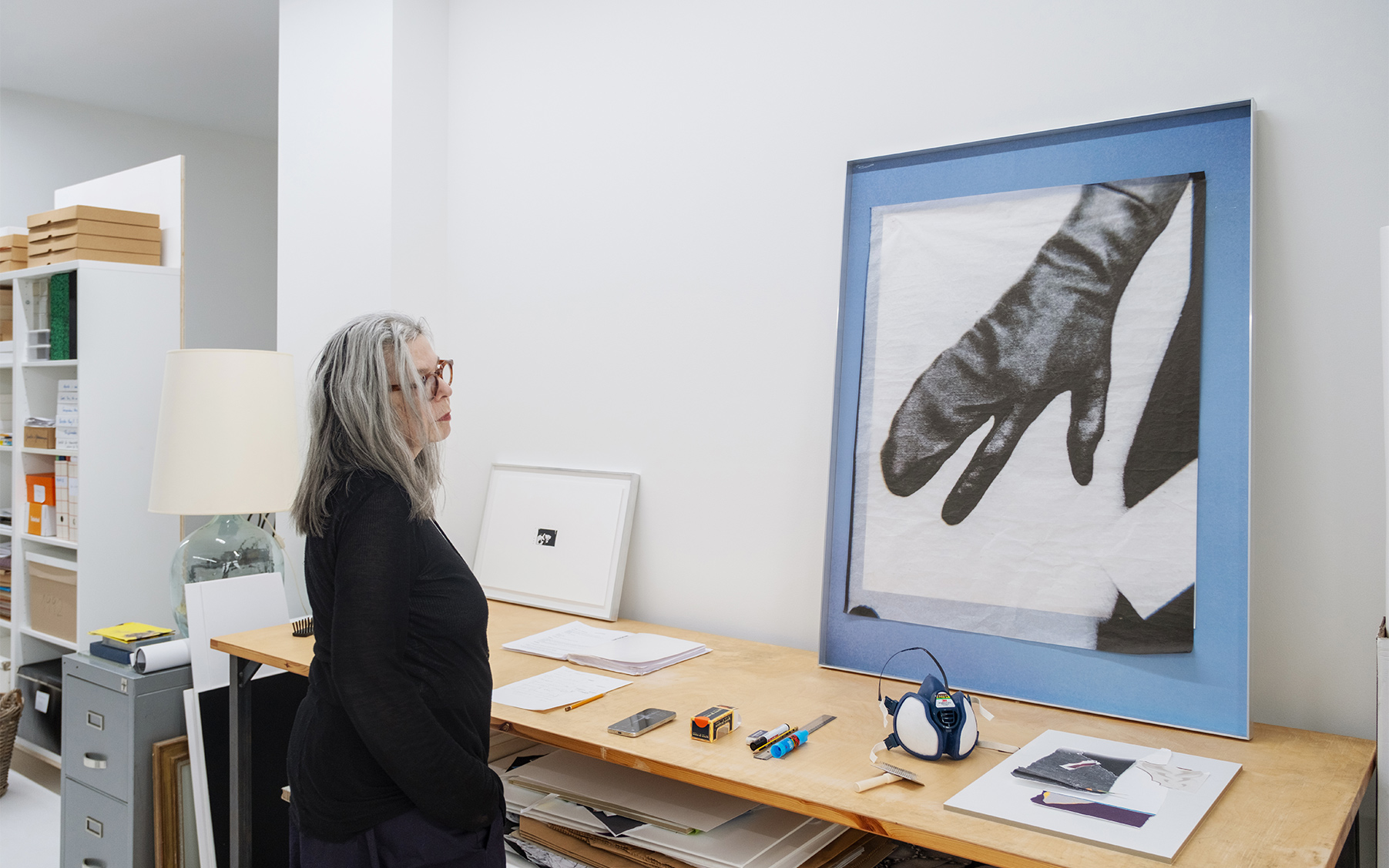
The Faces are also photos in the end result; the inspiration for them came when I saw a little girl's sticker book, who created a wild, uncontrolled abstract portrait from this game. So I started the series of collages. I photograph these when they are finished and make pigment prints on semi-transparent silk tissue paper using a special technique I developed; I wanted to move away from academic photo paper when the transition from analogue to digital took place. The Faces could also be seen as self-portraits; today, I find that almost all of my works can be classified as self-portraits.
Because you find yourself in everything?
Yes, that's how I see it today. All these psychological and emotional constellations and states, often chaotic, come together in my objects.
It seems as if the planned and the playful come together in your work—is that intentional?
Yes, absolutely. That's my intention! It's an almost childish rebellion against the established rules, the urge to find freedom, to look at things in a new way. And to give them a new constitution. As a child, family circumstances forced me into the adult world, and play, which was not part of my childhood, has become an important component of my work.
Bringing opposites together, not thinking in categories – that leads me to your collaboration with fashion designer Martin Margiela. He, too, didn't just create fashion, but pushed the boundaries of art?
Margiela had seen my reportage photos, and he was interested in my approach, which was not fashion-oriented. I found his work exciting because it was so artistic. Our collaboration falls into the category of my commissioned work.
Do you distinguish between commissioned work and your own work?
Yes. Actually, I only ever accepted commissioned work when I had carte blanche. I make that distinction, even though my perspective always remains my own, of course. I sometimes appropriate things that were originally commissioned work. That was the case with Margiela, for example, where I gave the photos from my archive a conceptual form after some time had passed.
For example?
About ten years after Margiela's retirement, around 2018, I began to take a fresh look at my Margiela archive; that is, photographing all these Polaroids, photocopies, baryta prints, negatives, and contact sheets with my camera. I simply took a fresh look at them. This resulted in a newly photographed series of existing photos. The Archive Box consists of ten selected prints from this series, each using my silk tissue paper printing technique. It's wonderful to create something from something that already exists!
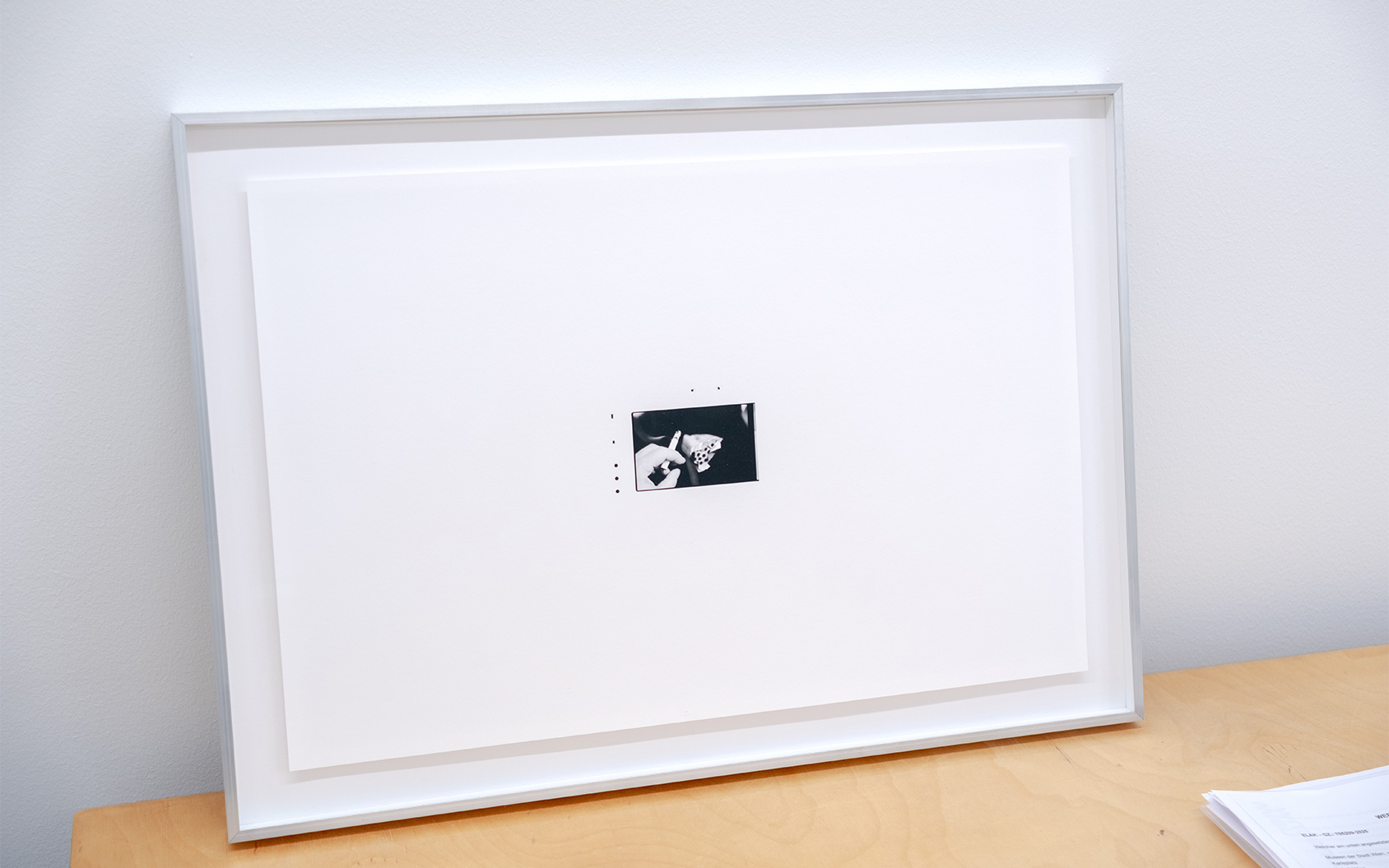
Is it also a retrospective of a point in your career?
Margiela is so present that I can't see it as a retrospective. I was just invited again by MM6, a side label that is most loyal to Maison Margiela, to photograph backstage at the shows. Somehow, it seems to be just continuing. A book is also in the works...
You can't get away from it!
True, it has become part of my life. The difficult thing is that the outside world can't necessarily tell the difference. There are some things that the public thinks are Margiela, but in reality they are mine.
Does it bother you that the two are sometimes confused?
There are people who are very concerned about how they are perceived. I mean, people can think what they want about my work. But it took me a while to come to terms with that... you cannot control how people see you as an artist. As far as Margiela and I are concerned, we shared a common sensibility and aesthetic.
And do these sensibilities and aesthetics keep coming back?
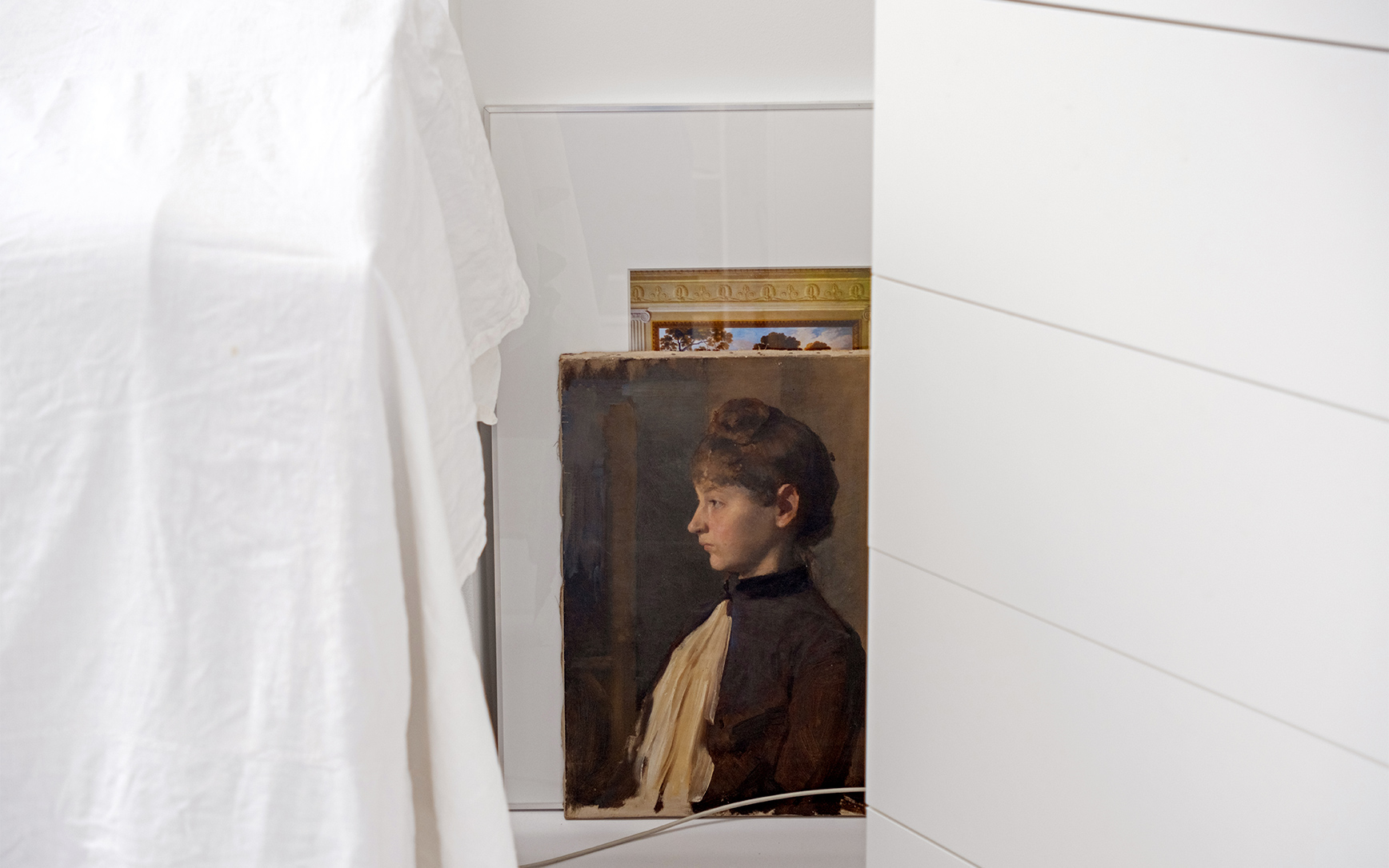
Yes. I will soon be exhibiting objects that I created in the early 2000s. After the fashion shows, there were always individual shoes left over, which I was allowed to collect. So I picked up and collected many other brands of shoes, sandals, ballerinas, and stilettos in the Margiela showroom, as well as chairs and stools, most of which I found on the streets of Paris. I started a series for which I deconstructed and reconstructed shoes.
But you don't just work on the shoe series, you also use “objets trouvés” for other sculptures?
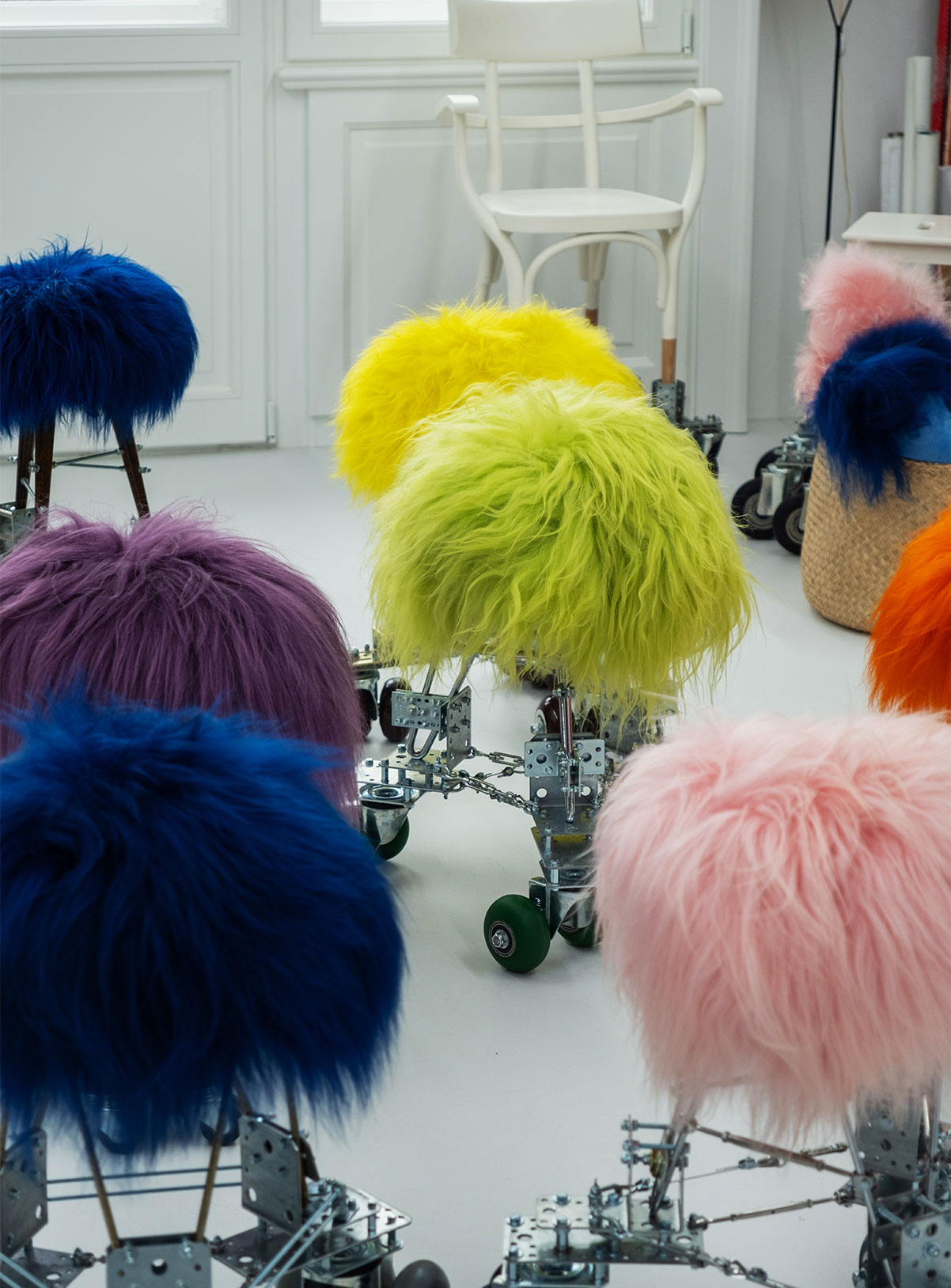
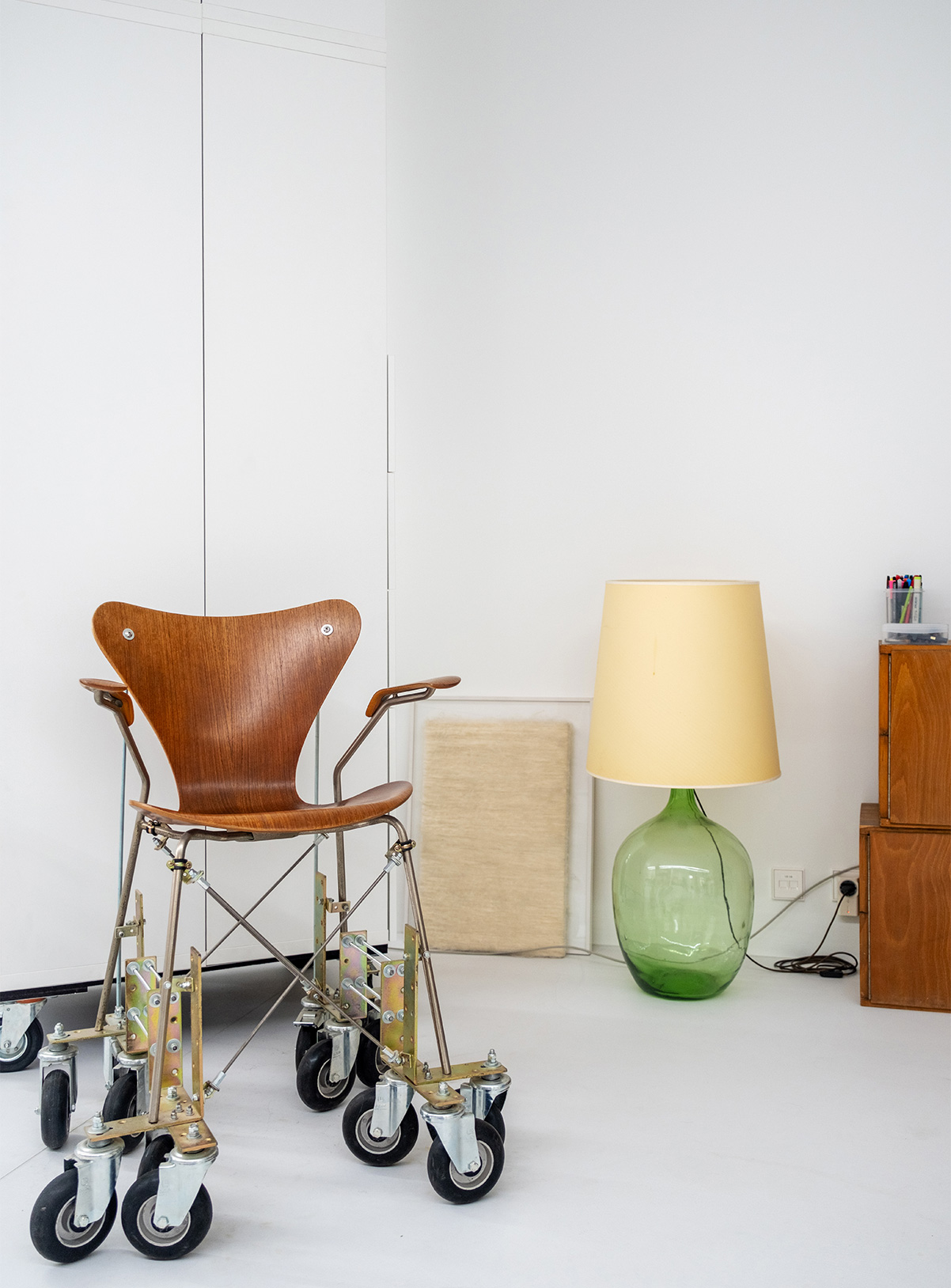
Yes, absolutely, both in my Traveling Chairs and Rolling Stools, as well as in the assembled chandeliers that I call Ambulants. It's about giving things a new existence. And about not respecting categories: there isn't just masculine and feminine, nor gentle and brutal, or only one function; everything is included in everything. The delicate and the hard—I like to bring these things together and I am against separating them.
So your art can extend to different objects—chairs, stools, shoes, chandeliers—because it's about the concept, the idea...
Exactly! For me, it has to make sense, convey a mood or complexity!
What do you think is the common thread in your work?
Everything comes from encounters with things or objects that come my way. For example, the Traveling Chairs were created when I was shooting my film Gallerande. We were a team of nine people in a castle in France, filming each other in an endless loop. And when you have a minimal budget, you always use these hospital chairs with wheels for the so-called traveling shots. But I found that these had too many connotations, so I preferred to make my own. So I converted old chairs and put them on wheels—as functional objects.
Art that can also be used!
Yes. So I thought that they could also be used in exhibitions and museums; you sit slightly elevated, you're in motion, and you're interacting with an exhibit. Last year in Paris, I had an exhibition where my Faces were hung in a line on the wall like in a picture gallery, and people rode each other along the wall on the Traveling Chairs to look at them. Being in motion puts you in a meditative mood.
And the Rolling Stools?
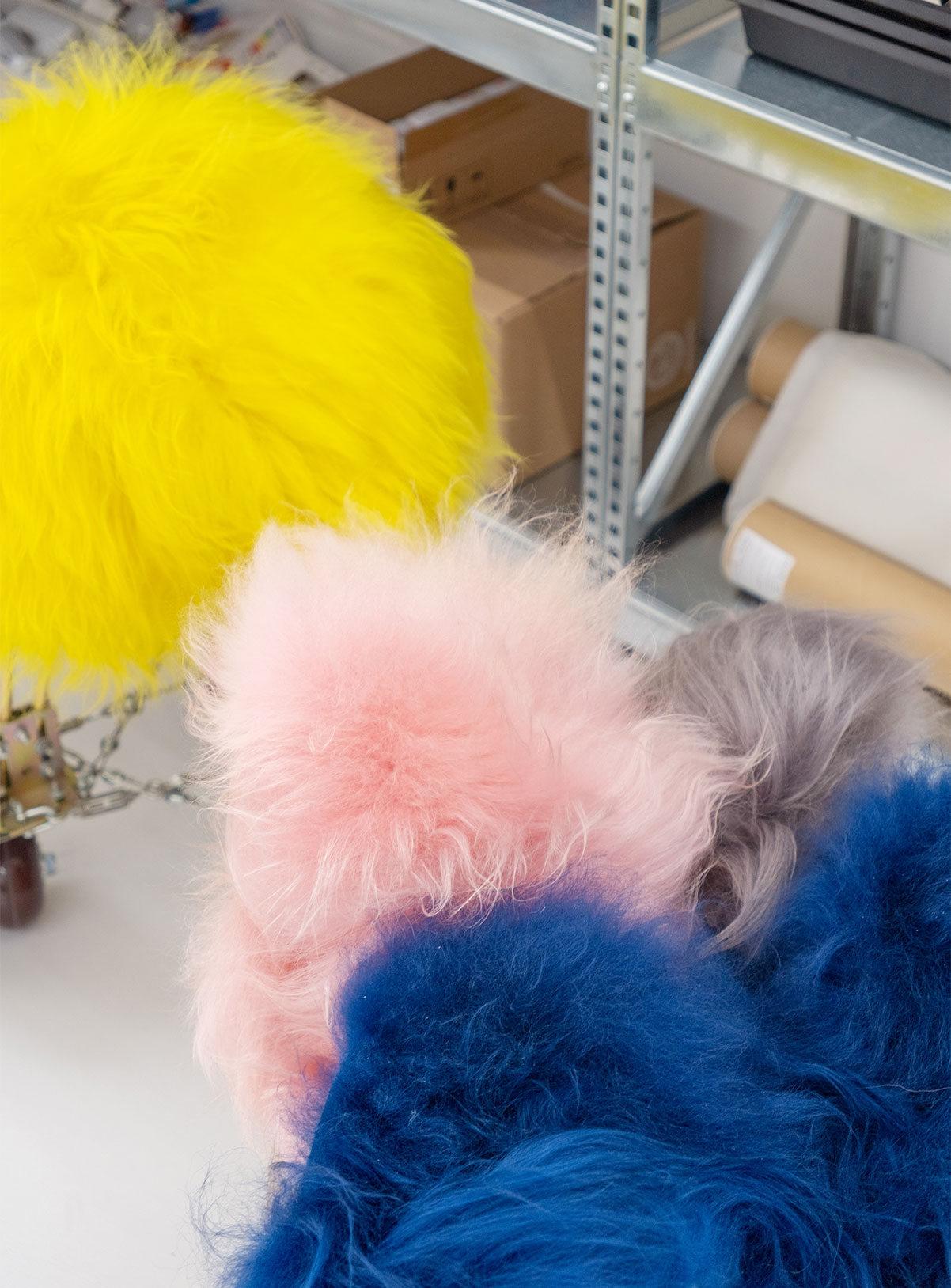
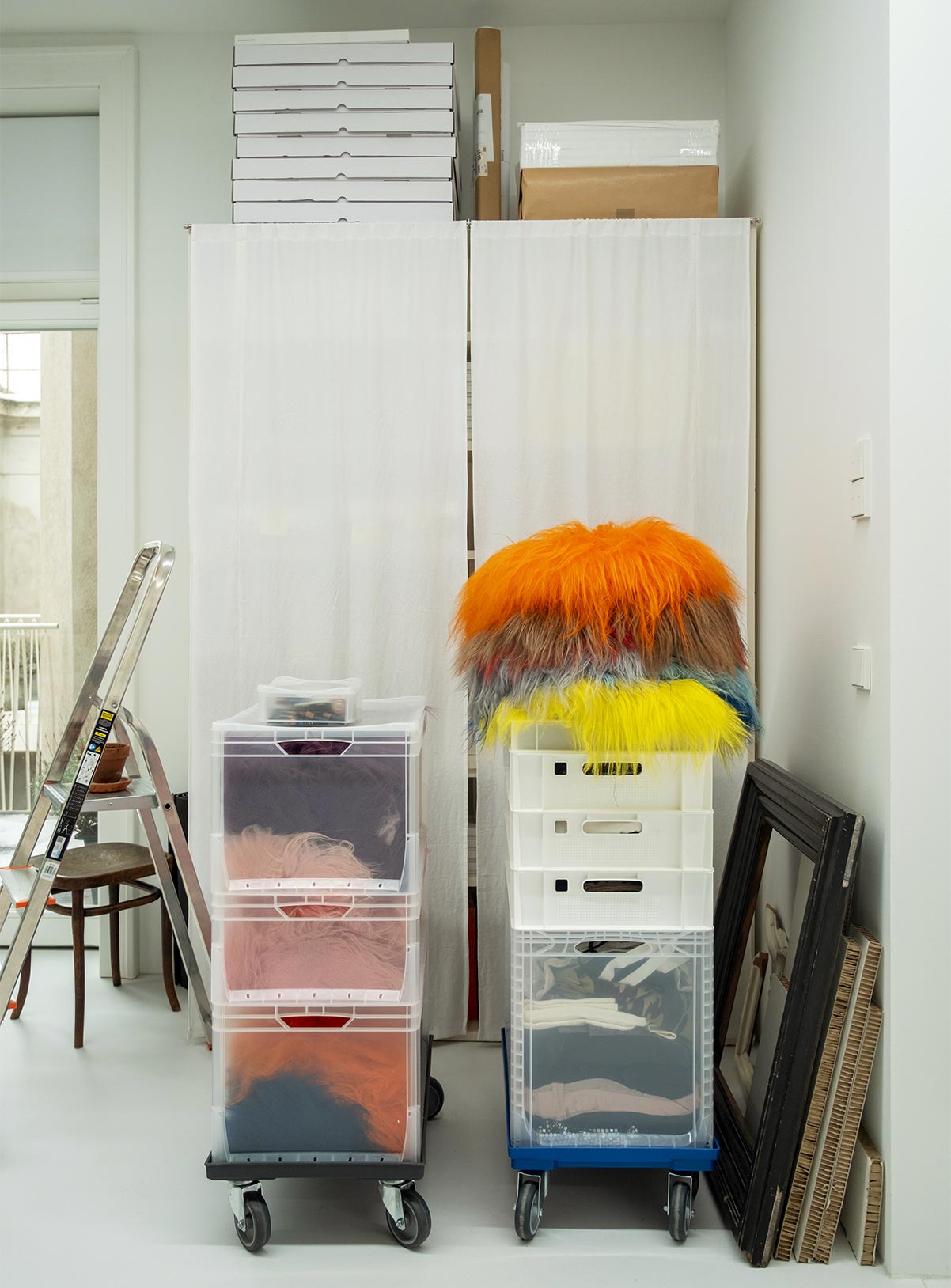
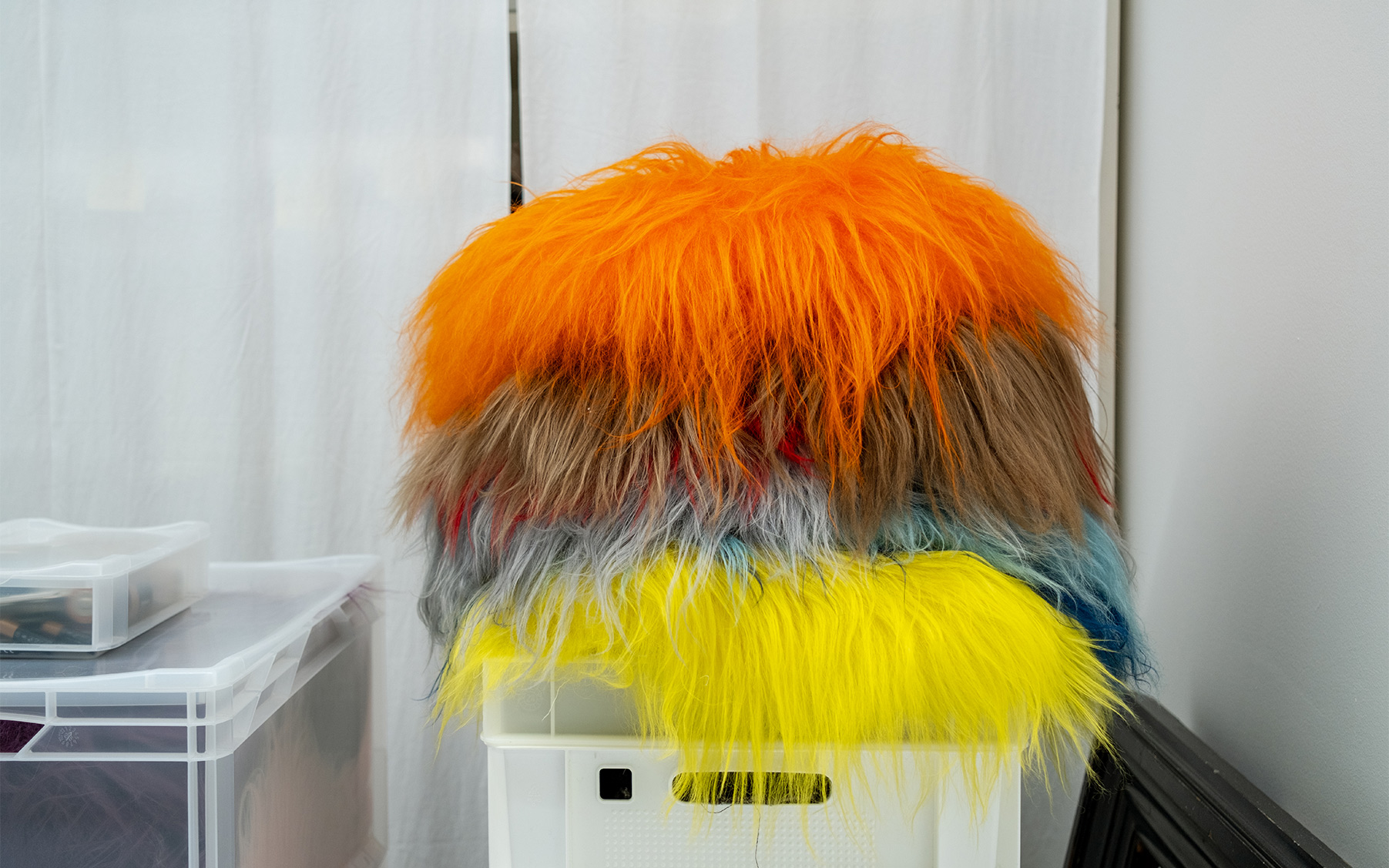
They came later. I discovered these low makeup stools that are brought up to normal chair height by the casters and are therefore not as high as the Traveling Chairs. With their industrial designs and colourful covers, they become little creatures.
And how did the chandelier objects—the Ambulants—come about?
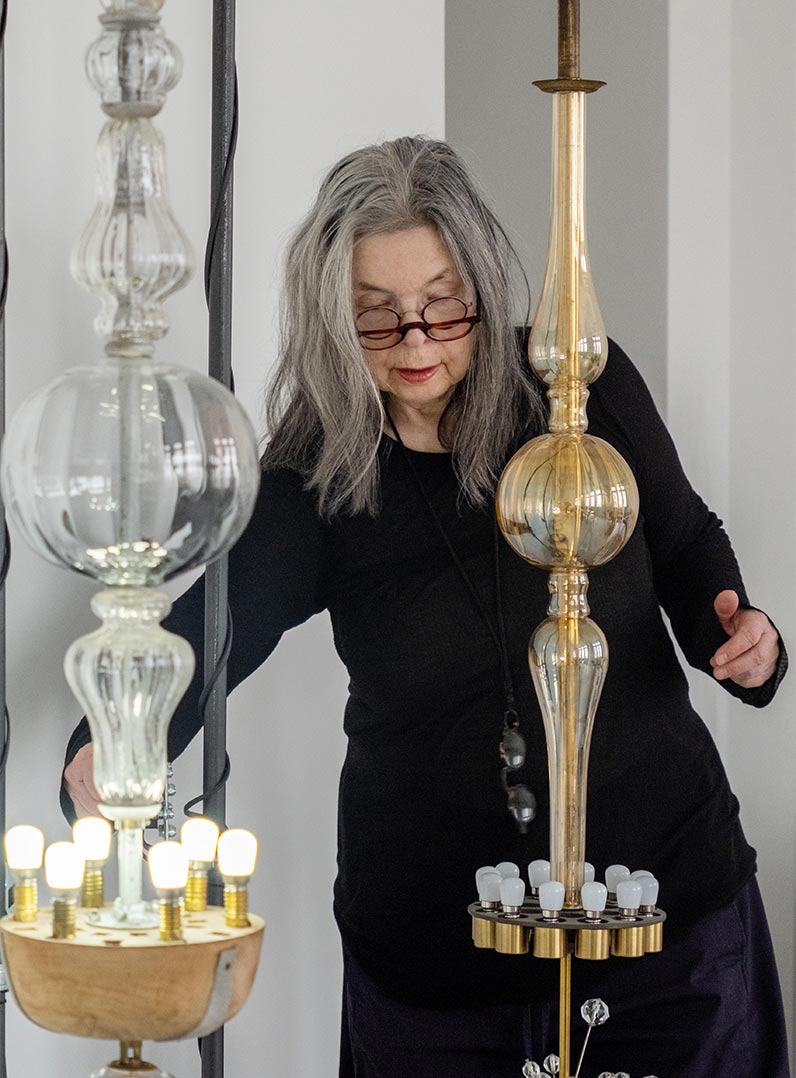
I've always liked chandeliers, but not in their bourgeois form. I traded a Rolling Stool with a friend for two chandeliers. It took a while, I looked at them for a long time and then at some point started to rebuild the chandeliers. I mix fragments of different origins and periods.
There's something didactic about that, isn't there?
I don't mean it to be didactic. I like working with things that already exist. The world is already so full of stuff! Today's new materials, these huge productions in art, into which so much money flows—something often gets lost. I work differently. With the chandeliers, for example, I assemble lost or broken pieces that would otherwise no longer exist. It's also a relationship with the past, with art history, which is mine, which I carry within me. Sometimes it's also a relationship with the future. Incidentally, an Ambulant was exhibited at the last Art Basel in the Social Club. It looked good there, contrasting with its environment and in the midst of all the buzz.
If you only reuse what already exists, you limit yourself. Are you comfortable with that?
Yes, I don't see it as a limitation, it's more of a kind of support. The objects give me a basis and I build on that.
Where do you get the parts if you can't find a friend?
I find a lot of things at dealers, online, etc. Later, I had a meeting with the glass and chandelier company - Lobmeyr. They opened their attic to me and provided me with parts, and it was an extraordinary stroke of luck. Some of my chandeliers now consist of Lobmeyr parts. Eclectic objects consisting of parts from the 18th century to mini Sputniks from the 1960s.
Lobmeyr must have liked it too?
I hope so. It's also important to me that the light from the bulbs is a cold daylight, which for me creates a connection to photography. There's always a connection to photography, because chandeliers offer light and movement.
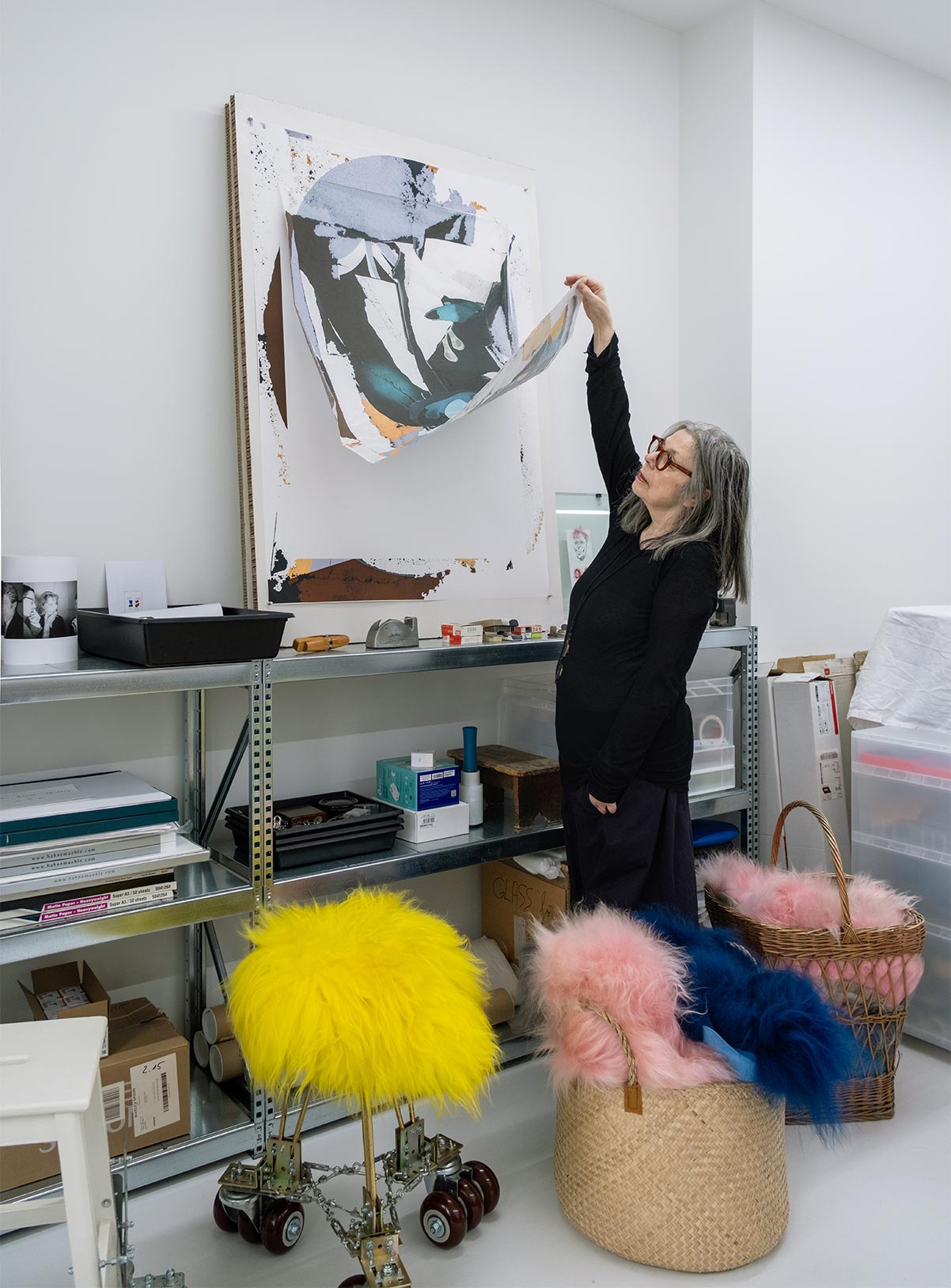
Where do you work?
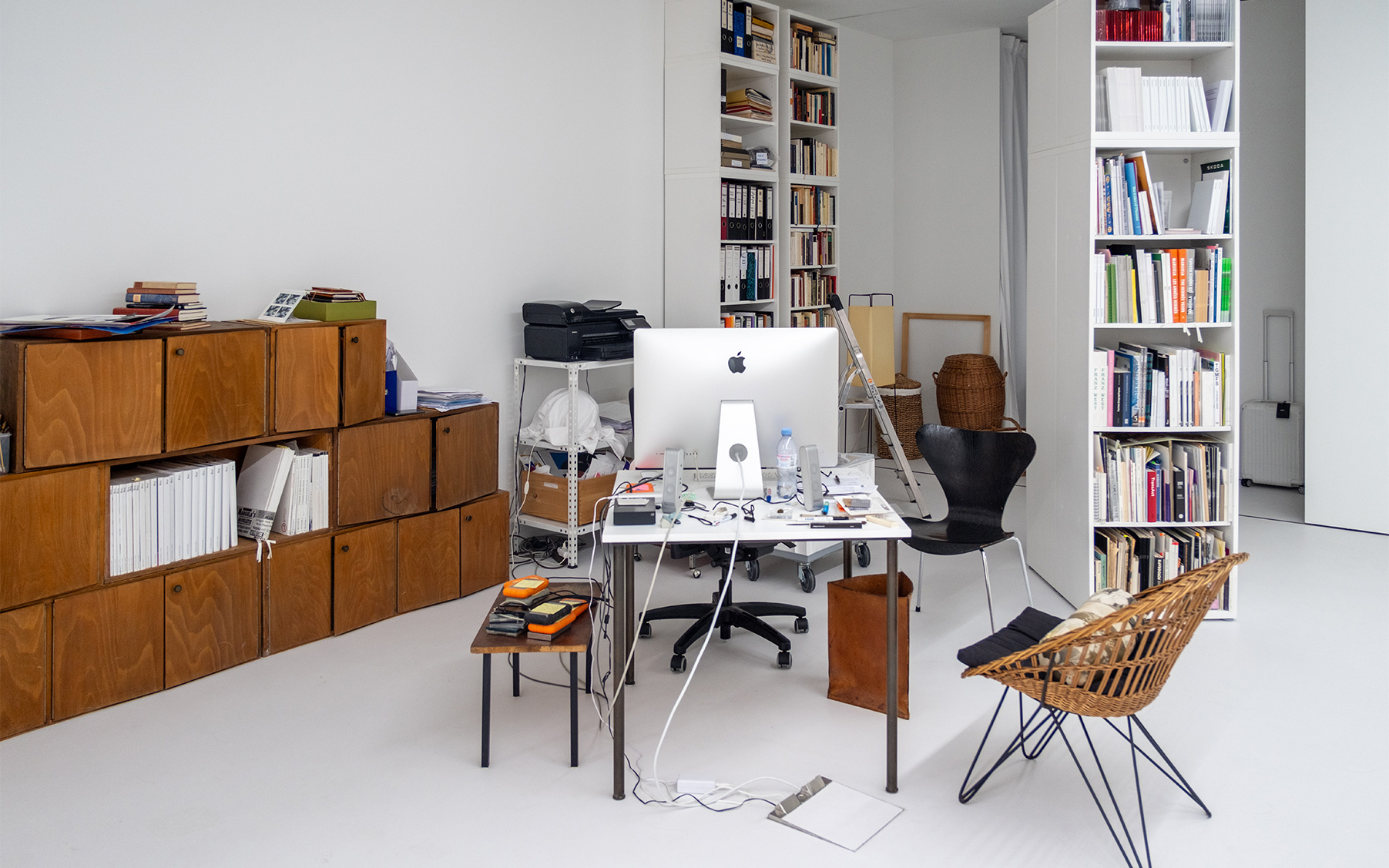
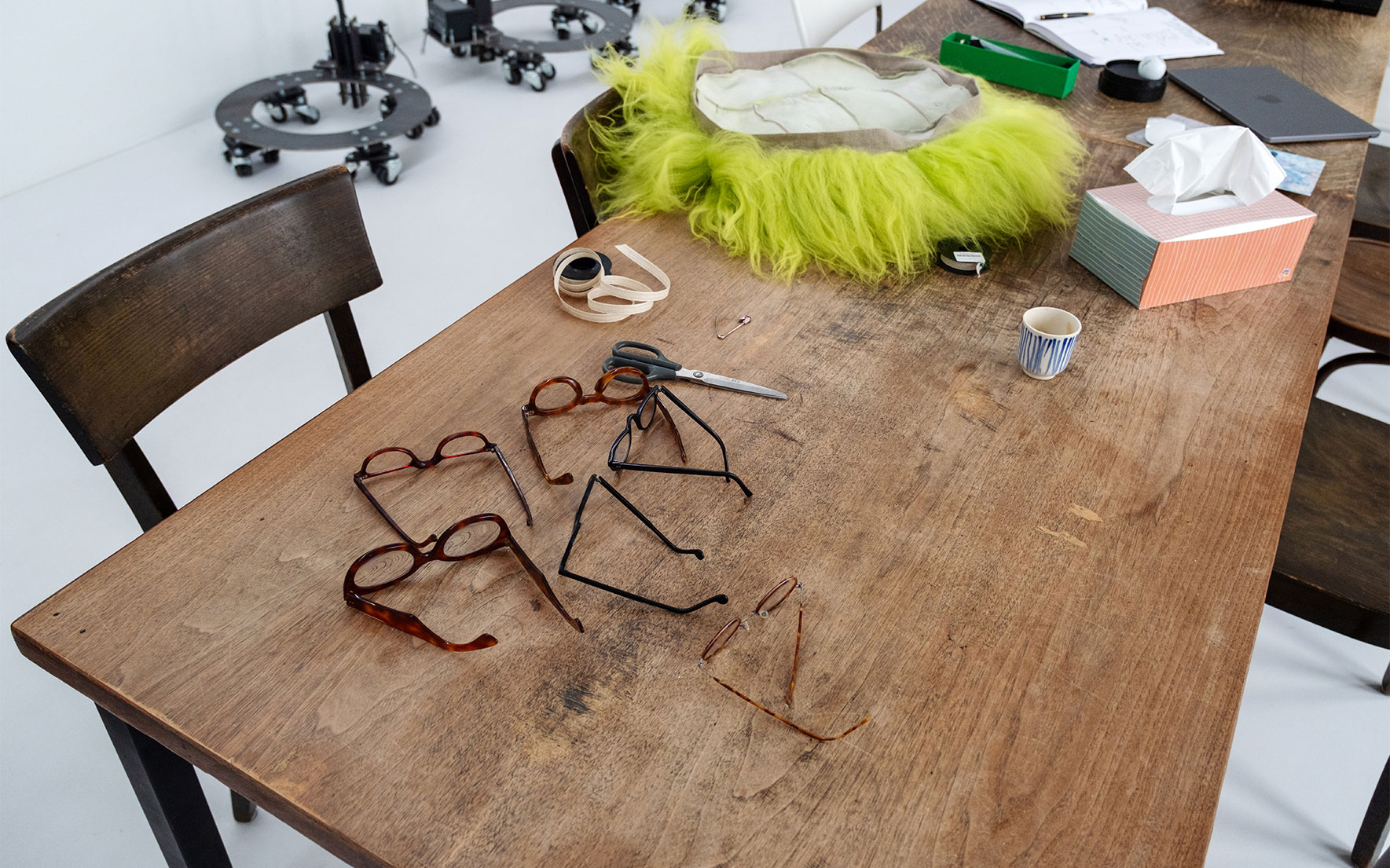
Here in my studio, with employees when it comes to sculptures, and with a technician, in whose own studio I also produce. I myself have a mechanical brain; I am more of a builder.
What are your next projects? The sculpture I see here, for example?
That's a new work that I haven't named yet! It's a sculpture that works like a room divider... In March, there will be a group exhibition at Villa Merkel in Baden-Württemberg by collector Lukas Jakob. In January, an exhibition began at the Xippas Gallery in Geneva with the Traveling Chairs, and another at the Centre Jean Cocteau near Paris. After that, there will be a solo show at Phileas in Vienna in April and a solo exhibition in the fall at the Frac-Arthotèque Nouvelle-Aquitaine Limoges, where, among other things, shoe objects of mine will be shown. In November, the exhibition Franz West and Vienna will begin at the Wien Museum, where I was invited to take on the artistic design. This year is intense!
How do you feel about working in Vienna?
I think it's wonderful to live and work here. It's quiet, but sometimes I miss the big city atmosphere that I like so much in Paris, for example. But Vienna has many alternative venues for art and an exciting art scene. There is a sense of complicity, an exchange between artists. Perhaps there is a slight lack of committed collectors, as in Germany or Switzerland... But it is an island in this world—there is no other place with the comforts of Vienna.
In your opinion, is it more difficult to launch an international career from here?
It used to be. But it has improved a lot over the years. I have great admiration for Franz West, who was a dear friend. He stayed here and created such a universal body of work. Few artists from that time in Vienna succeeded in doing that - I had to leave the city again and again to break away and then come back.
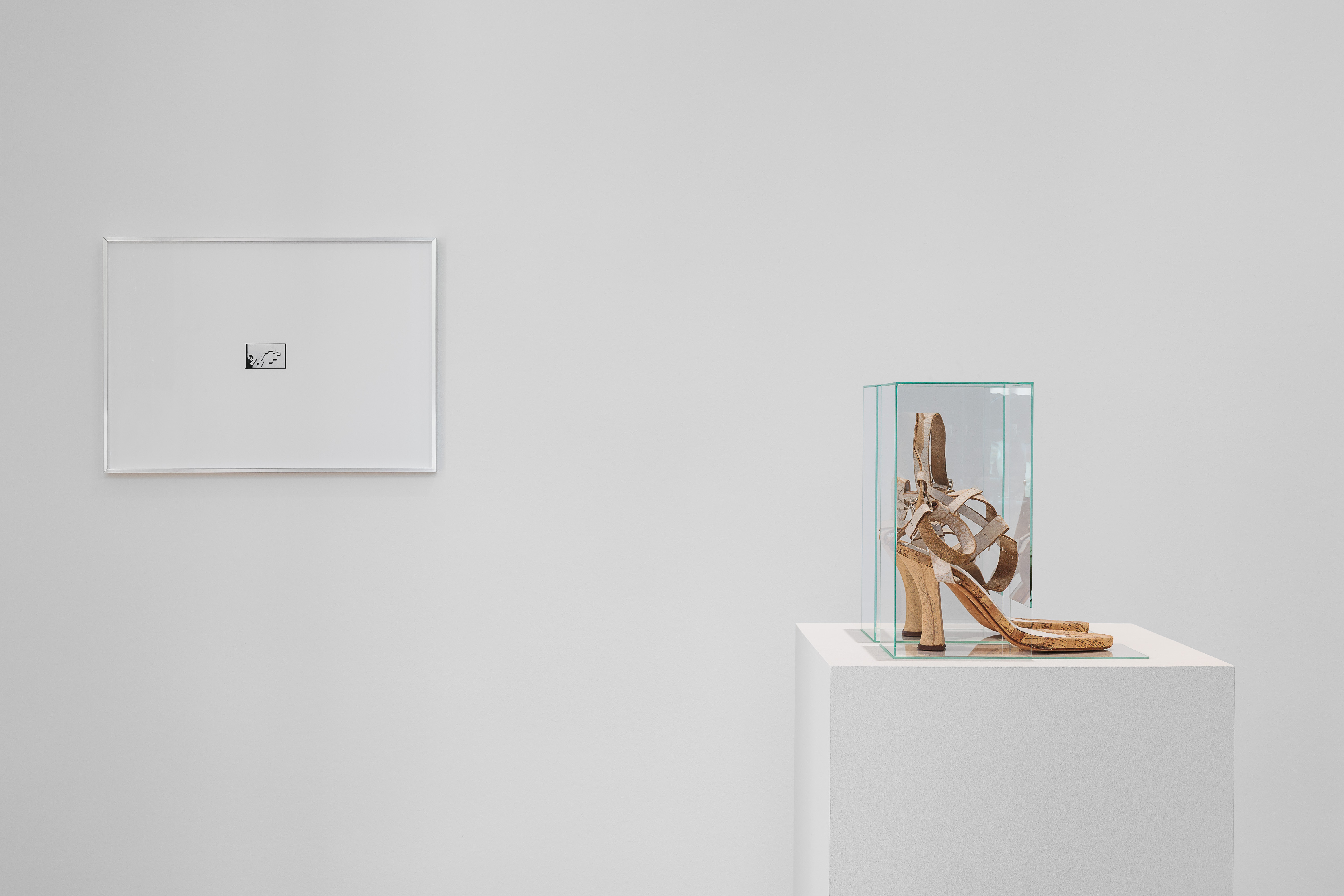
Marina Faust, Ausstellungsansicht von VON BIS / FROM TO bei Phileas, 2026. Foto: Kunst-Dokumentation.com/Manuel Carreon Lopez
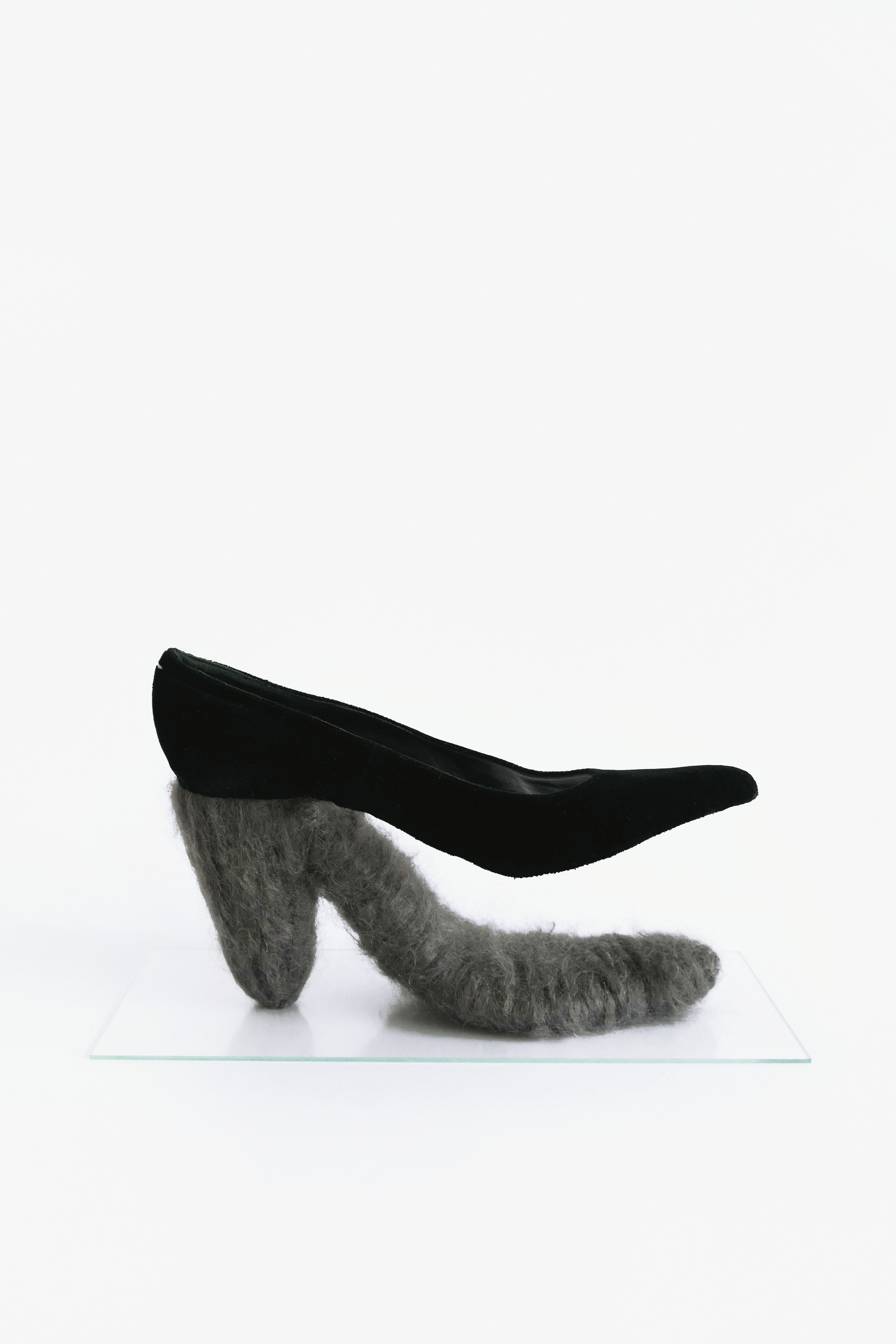
Marina Faust,Untitled (object nr. 06), 2005
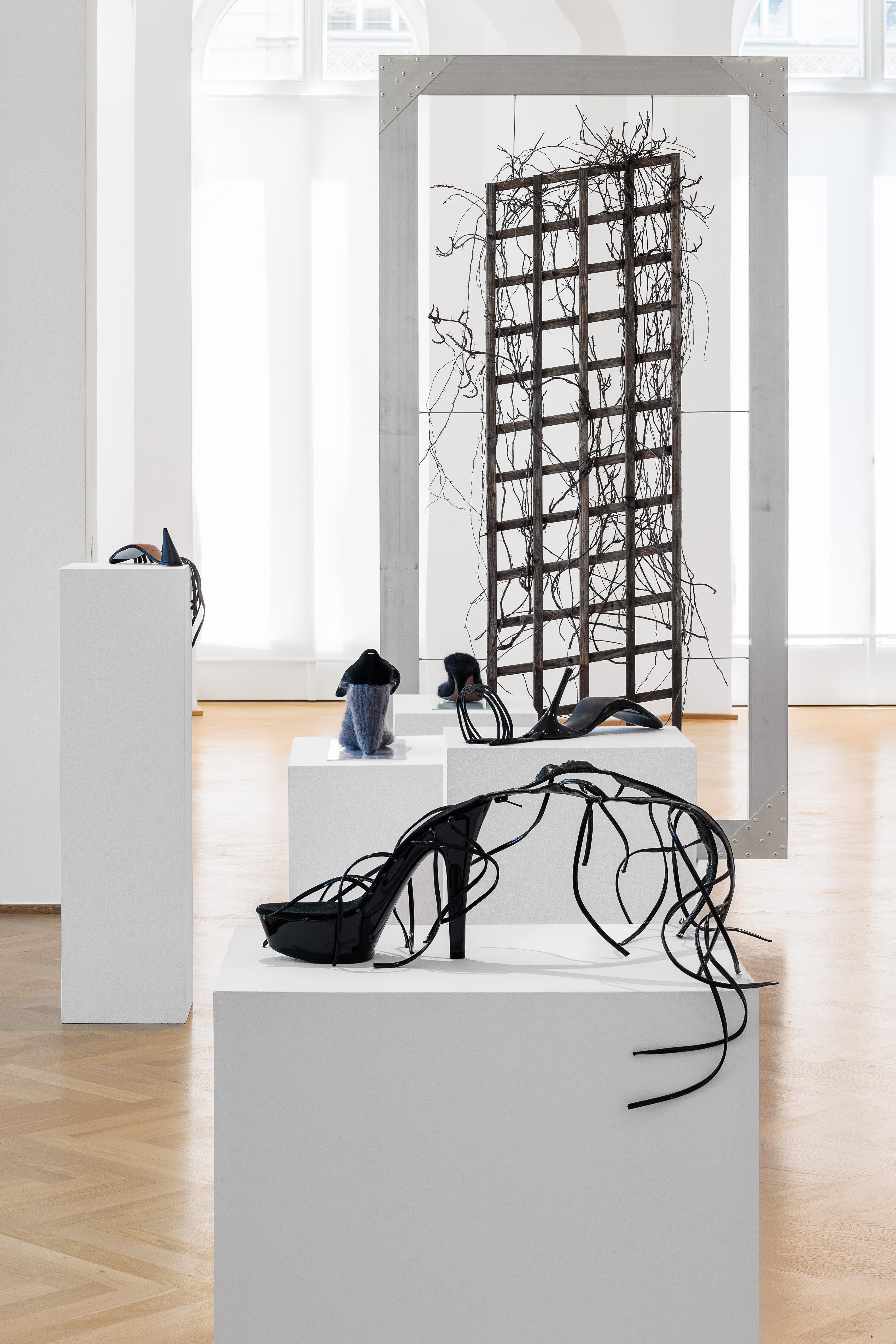
Marina Faust, Ausstellungsansicht von VON BIS / FROM TO bei Phileas, 2026. Foto: Kunst-Dokumentation.com/Manuel Carreon Lopez
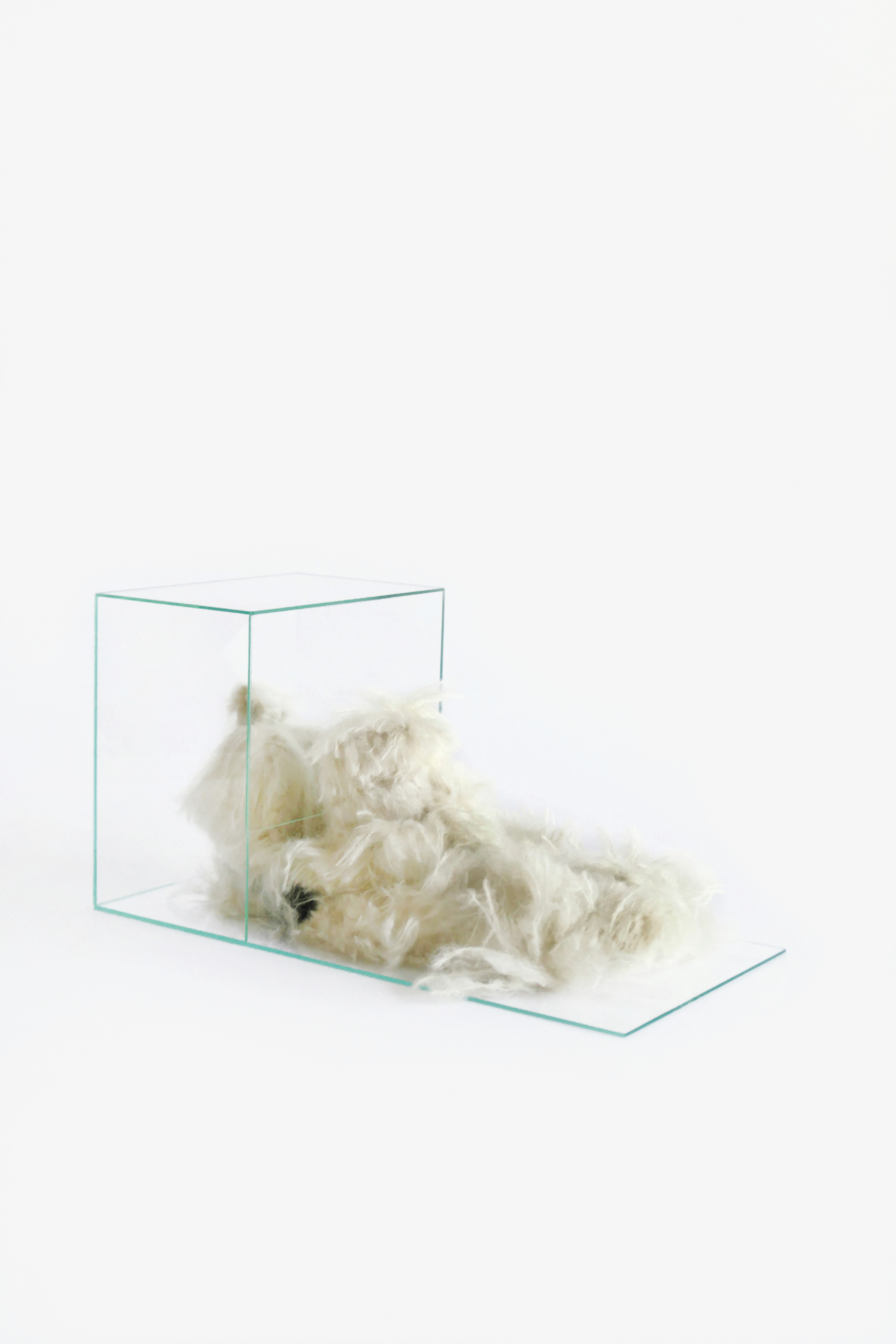
Marina Faust, Untitled (object nr. 12), 2005
Text: Alexandra Markl
Photo: Maximilian Pramatarov