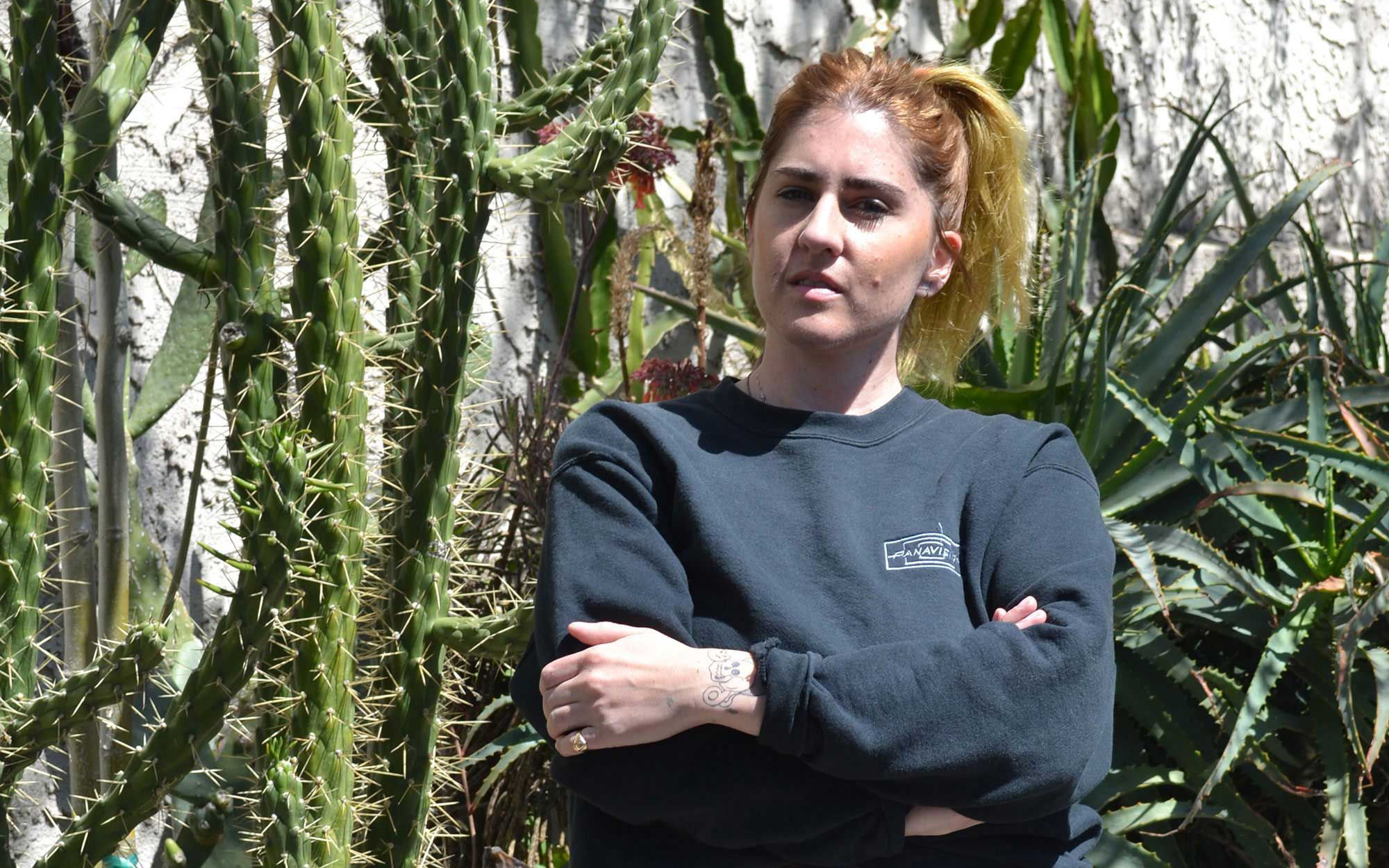
American artist Megan Plunkett turns away from depicting people, instead focusing on everyday objects. Drawn from consumer culture, and the film industry, her carefully constructed photographic series cultivate a sense of estrangement within things that might otherwise feel familiar. Rather than a closed reading, the audience is invited to take time in looking and to consider how images live in the mind’s eye.
Megan, you’ve just opened your solo exhibition Welcome In at Emalin in London—how has it been?
I was very excited to do something at The Clerk’s House that Emalin has. It’s one of the oldest buildings on Shoreditch High Street in London, so it has a really storied history—including a strong belief that it’s haunted. It was interesting to show in such a special exhibition space, especially with the objects I’ve been working with and the content of the images. A lot of objects and props I work with tend to be things that I would describe as being “at hand”, including things like bottles and cans, but also newspapers and trash cans. It felt appropriate to lean into this for the show, drawing out a kind of tweaked economy around the domestic, the things that lurk around us.
How do you usually describe what you do as an artist?
I usually say I’m an artist who works with a camera, or that I’m an image maker. There’s so much rhetoric around photography, and the 20th century is so heavy with photo theory. But for me, making images, making pictures—that’s what feels most true to what I do. I love using a camera. It’s such a special tool—you’re mediating what you see into something new, and there’s something really magical about it.
What drew you to photography in the beginning?
In high school, I loved collage, and later in college I studied printmaking. It felt like such an archaic choice—I was around 17 and really into punk and D.I.Y. ethos, so printmaking felt appropriate given what I was interested in. Working in printmaking, and thinking in terms of repetition, sets, and series, there’s a kind of internal logic that’s still very present in my work. It was also a very technical process. Over the course of my printmaking period, I became mostly focused on silkscreen and photolithography, mainly because those two processes allowed using images from the real world. I was using found images, manipulating and reprinting them, and so on. That was really the foundation of my work. After I left school, I began to think that maybe the next step was working with a camera, generating my own imagery.
Do you remember your first camera?
One of my first serious cameras was the Nikon D3100—an older digital SLR. It was a really utilitarian tool that carried me through a lot. I’ve always worked with both analog and digital. Each has its own kind of magic and offers something different. In the beginning, my analog experience was mostly with point-and-shoots—cameras I’d find at flea markets or thrift stores, and also Nikon N50s, which is the camera the gallerist gives to a photographer Pecker in the iconic John Waters film of the same name. I remember seeing that specific model in the film and seeking it out because of that. Ironically, it’s a camera that Pecker hates for being too fancy, even though it’s such a simple 35mm point and shoot. What I love about analog film is the sense of the unknown. When you get your film back, there’s always that moment of wondering what it’s going to look like.
One unexpected part of your biography is working as a private detective assistant—how did that happen?
After studying in New York I eventually moved back to Los Angeles, where I grew up—in the San Gabriel Valley. At the time, I was working for a group of artists, and they knew the P.I. I ended up working for, so they pointed me in that direction.
There’s a familiar pop-culture image of a private detective sitting in a car with a long-lens camera, surveilling people—how did your experience compare to that?
It was not like that at all. I feel there’s maybe even a psychic presence in Los Angeles in my work. I’m from here, I choose to live here—it’s inescapable. Even the figure of the private investigator feels tied to this LA-centric media history, going back to noir and writers like Raymond Chandler. It felt like a rich space to think through, or to tune into different visual tropes and how they shape the way we perceive space. But I definitely wasn’t doing the more showy side of that work—there’s a whole world of people who specialize in those roles. I was very much an office dweller.
What impact did that job have on your way of making images?
In grad school, I was writing a lot more than you might in your day-to-day practice as an artist, and I was also doing a lot of writing at the PI job. It was interesting to hold those two modes at once: legal writing versus art writing. I think it really helped me think about precision in my own work. I was thinking about this idea of suggestion—the way you might state a few facts in a row, things that are provably true, to suggest something else that is harder to place in language. There’s something similar in photography: how you can string images together to suggest something larger than their individual parts. The whole can become bigger than the sum of its parts, and you start to play with assumption and perception in that space to create a kind of breakthrough.
Did your time working in private investigation also influence your decision to focus on objects rather than people in your images?
I’ve never really worked with images of people—that’s just never been my interest. I’ve always been more drawn to objects and things. It doesn’t feel that hard to imagine the material traces of the world, almost in a sci-fi, dystopic sense. I was thinking the other day about Roadside Picnic by Arkady and Boris Strugatsky, which inspired Andrei Tarkovsky’s film Stalker. In the book, aliens visit Earth and leave behind what’s essentially their trash—like they stopped for a roadside picnic and then moved on. And humans are left trying to make sense of these objects, searching for meaning. But it’s just trash. Something about that feels really exciting to me.
The objects in your work often come from consumer and media culture—like beverage cans. What draws you to them?
At different points, I’ve been influenced by aspects of object theory—thinking about how objects relate to us, whether they reflect us or not. I am also drawn to ideas from object-oriented ontology—this notion that objects have their own kind of agency, and how we might begin to define or look at that. All of that is in the mix in my work.
How do you go about finding the objects you work with and capture?
When I find things, they come from different places—prop houses, my own stuff, objects from flea markets or thrift stores, sometimes things I make myself. They’re all part of these circuits of material circulation that I’m interested in. A lot of it is intuitive. Sometimes I’m drawn to a certain look, but other times it’s more about a feeling. I would say I’m looking for objects that can be a vessel or container for thoughts or beliefs, and thinking about how we can twist the imaging of those things.
Your work often feels cinematic, and some of your titles reference films. For example, one of the works in Emalin was titled Time Does Not Exist and Yet It Controls Us Anyway, drawn from the film One Battle After Another by Paul Thomas Anderson. How does cinema feed into your practice?
Film is a big influence for me and often my main reference point for looking. I just love watching films. What interests me is the kind of construction that happens in film, and how believability is built. You always notice when something is off—if you’re watching a period piece and something doesn’t fit, it breaks the spell. For me, all these tiny decisions contribute to a whole picture that’s about suspension of belief and believability within us, and the triggers that shape that experience. It is similar for me in the studio, I am interested in the “cues” we rely on when we are looking, how that strings together meaning.
What kind of experience do you want the viewer to have?
Maybe looking at images takes a certain kind of patience—especially in our AI-slop world. I’m wondering how you actually make an image that can break through to someone, when there’s this constant onslaught of imagery that may or may not be real. It is a highly confusing time to be receiving images. I hope my work can offer a kind of stillness in looking—an invitation to take things in slowly, and to consider how they live in our mind’s eye. I’m interested in how we receive things, because in a way, everything becomes an image. Even when you’re looking at sculpture in books—if you’re not seeing it in real life, is it just an image? And even when you’re not in front of a sculpture, you’re always relying on your own internal image of it, on your imperfect memory of how something looked, or felt to look at. That tension is really interesting to me. I hope my work can engage it, and maybe ask something of the viewer that isn’t machine-image based—not a news image, not an AI image, not something you just scroll past—but something that actually makes you wonder.
Was stepping away from Instagram connected to this way of thinking?
I think that’s actually connected to what we’ve been talking about. I remember reading the American artist Carol Bove’s Self-Help Guide for Artists after I got out of grad school, and it really stayed with me. She talks about a kind of “garbage in, garbage out” mentality, and a sensitivity toward media. There’s a line where she says, essentially, that whatever you think your media intake threshold is, it’s much lower than you believe—and I really think that’s true. I reached a point where I wanted to be more deliberate about how I receive images.
Back to your practice—could you walk us through your process of making the photographs?
I get caught on a specific object and think, okay, let’s take that as a starting point. From there, I begin bringing together rented, bought, or found objects and arranging them in different ways. It’s a very playful process in the studio, setting up low-key scenarios. There are a couple of places around Southern California where I go to shoot, mostly in the desert—locations that are accessible to me and that I already know visually. It becomes like my own roaming, ad hoc studio world. In a way, it’s still life building that snowballs over time, and maybe even space, gradually growing. I tend to get hooked by a type of object, or even just a color—something that opens things up for me, where I start thinking, what can we find here?
What else is important for you when you’re building a set?
In the studio, I mostly use repurposed lights from domestic settings rather than professional photographic setups. It’s less about technical lighting and more about creating an ether or aura around the objects—something I can almost latch onto. I shoot mostly with an F6, a 35mm film camera that I really love working with. It’s so tactile and beautiful to hold. Lately it’s been exciting to lean into that camera as a primary tool. I also use a digital camera for certain things. Overall, it’s a kind of roaming still life caravan world—one that keeps gathering and building on top of each other.
In your work, images often appear in pairs or groups that challenge each other—how does that strategy shape the way you build meaning?
Usually it’s a wonder—if there’s one image, I want to match it or counter it and do something else. Just before COVID, I did formal image training as a forensic photographer. There is a concept in forensic imaging called the “matching image.” It is an image recreated from evidence that usually shows past action or movement. For example, if a hammer is found at a crime scene that has been broken, a matched image will show the parts of the broken object back together, to illustrate that, essentially, something happened. It is, very literally, a faked photo that acquires the force of law. When I learned about that it was a really exciting concept that felt like something I had been intuitively working through on my own. It probably goes back to my printmaking youth, but I tend to think in series and sets. There’s a lot of playfulness in building a kind of arsenal of image work.
What are you working on at the moment?
I’m working on a project for mumok Vienna called Terminal Piece, made in direct response to a work by the American feminist artist and writer Kate Millett, also titled Terminal Piece. In Millet’s piece, a female mannequin is seated in a black room with 42 chairs behind wooden bars. The work will be restaged at mumok. I am showing a large series of images that I shot in 2020. Around that time, I was practicing my forensic image work while also being a caregiver to my mom, who had dementia. She had been making small arrangements around the house, where she gathered up little things from the house into groups, like a bowl full of dice, glue, dirt, the garage door opener wrapped in paper, and light bulbs. I started to shoot her objects, these small assembled sculptures she was leaving around. Now I’m drawing those original images out into an extended series. It’s becoming a very tactile, physical process of making that involves a lot of re-printing and physical experimentation to push images of things which are no longer physically accessible to me.
How do you approach exhibition space when constructing a narrative?
What I find most exciting is when a space calls for a specific treatment, and I can really tune into how bodies move through it—how we feel in different environments, where the light falls, the sightlines, the areas where you can't see one thing for another. A simple example is something I’ve done quite a lot in exhibitions: placing a photograph against another photograph in such a way that you physically can’t see one while you’re looking at the other. It pushes you back into that idea of the mind’s eye—your body becomes a kind of conduit for remembering the other image while you’re in front of the one you’re seeing.
Are there any new ideas you’re looking forward to exploring this year?
I’m really excited to try new things. The show The Already World that I did at Sweetwater, Berlin in 2025 involved prop money laid out across the tables in the space. That experience got me thinking further about how props function, and how much bigger they can become. What if there are furniture props? What does that do to space? I’m interested in expanding those questions, maybe working more with controlling space, or pushing the idea of the tableau further. I’m planning some larger work around that—thinking about where I can take this idea of a prop even more into space and time.
Text: Anton Isiukov
Photo: Nicholas Gottlund